
Vernellia R. Randall, Weekly Racial Justice Update — July 12–18, 2026, Racism.org (July 21, 2026
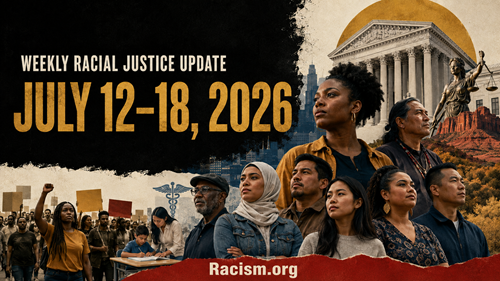
Federal officials moved to narrow civil-rights safeguards across education, housing, grants, immigration, and Tribal lands, while courts and community organizations mounted legal and public resistance.
The week’s major developments included the end of a 60-year Louisiana school-desegregation case, the newly disclosed withdrawal of federal fair-housing guidance, deadly immigration-enforcement encounters, an order sharply reducing Bears Ears National Monument, and new efforts to defend voting rights. Independent community-media research also identified undercovered developments involving Tribal water rights, a Chinese American scholar’s discrimination case, a Palestinian American activist’s digital privacy rights, anti-Muslim violence, and the information needs of Asian American, Native Hawaiian, and Pacific Islander communities.
Table of Contents
- Appeals Court Ends 60 Years of School-Desegregation Oversight in Louisiana
- HUD Discloses Withdrawal of Major Fair-Housing Guidance
- Court Blocks One Grant-Cancellation Tool as OMB Proposes Broader Political Control
- Faculty Groups Seek Injunction Against Texas Tech Classroom Censorship
- Civil-Rights Coalition Warns Health-Coverage Losses Will Fall Heavily on Communities of Color
- House Hearing Targets Diversity and Health-Equity Work in Medical Schools
- Civil-Rights Coalition Announces March on Washington to Defend Voting Rights
- Groups Move to Defend Mississippi’s Only Majority-Black Judicial District
- Fatal ICE Shootings Bring Protests, Foreign Legal Action, and a Reversed Safety Pause
- Report Documents Widespread Misuse of Crowd-Control Weapons at Immigration Protests
- Administration Narrows Legal Immigration Pathways Through Parole and “Public Charge” Actions
- Administration Asks Supreme Court to End Protection for About 600,000 Venezuelans
- U.N. Experts Warn That Removal of Immigration Judges Threatens Court Independence
- Bears Ears Order Removes Protection From About 1.24 Million Acres
- Four States Stall the Largest Tribal Water-Rights Settlement in U.S. History
- New York Report Calls for Reparations Without Further Delay
- AANHPI Survey Shows Why Language and Ethnic Differences Matter in News Access
- Chinese American Scholar’s Estate May Proceed With Most Claims Against Northwestern
- Court Finds Border Phone Searches of Palestinian American Activist Unconstitutional
- Utah Stabbing Investigated and Charged as an Anti-Muslim Attack
- Chicago Police Failed to Report More Than Half of Traffic Stops, Investigation Finds
- Bottom Line
- Search Note
1. Appeals Court Ends 60 Years of School-Desegregation Oversight in Louisiana
The U.S. Court of Appeals for the Fifth Circuit ordered an end to federal court oversight of Concordia Parish schools. The case began in 1965, when Black families challenged a legally segregated school system in a parish where the Ku Klux Klan had been influential. The Justice Department, which historically helped enforce desegregation orders, joined the local school board in seeking dismissal.
The appeals court used the extraordinary remedy of mandamus to direct the trial court to dismiss after the remaining parties agreed to end the case. The ruling did not rest on the usual judicial finding that the school system had eliminated the remaining effects of state-imposed segregation.
Why It Matters
Desegregation orders are not meant to punish school districts forever; they are meant to remain until unconstitutional segregation and its continuing effects have been removed. Ending supervision without a full public record on student assignment, discipline, faculty, facilities, and other measures may leave Black families with fewer tools to challenge unequal conditions. The Justice Department’s changed position also signals a broader retreat from federal enforcement of historic school-desegregation cases.
Sources
- Associated Press, “Federal Appeals Court Ends a Decades-Old School Desegregation Order in Louisiana” (July 15, 2026; last visited July 21, 2026).
https://apnews.com/article/0d4f5f4a67985fc6520e204c461c013a - Reuters, “Appeals Court Ends U.S. Oversight of Louisiana School System Related to Desegregation” (July 15, 2026; last visited July 21, 2026).
https://www.reuters.com/legal/government/appeals-court-ends-us-oversight-louisiana-school-system-related-desegregation-2026-07-15/
2. HUD Discloses Withdrawal of Major Fair-Housing Guidance
On July 17, the Department of Housing and Urban Development published notice that its Office of General Counsel had withdrawn 13 guidance documents. The notice said the withdrawal had been effective since September 25, 2025, even though the public notice came almost ten months later.
The withdrawn materials addressed coordination with the Justice Department, pattern-or-practice referrals, criminal-record screening, language access, discriminatory land-use practices, proof in Fair Housing Act cases, protections after Bostock v. Clayton County, special-purpose credit programs, appraisal discrimination, admissions and evictions in federally assisted housing, the Violence Against Women Act, a landlord exemption, and source-of-income restrictions. HUD described the documents as nonbinding and said they should no longer be treated as authoritative.
Why It Matters
Guidance does not create a new statute, but it tells investigators, housing providers, lenders, local governments, and the public how an agency understands and enforces existing law. Removing guidance across so many subjects weakens consistent enforcement and makes it harder for tenants and homebuyers—especially people of color, immigrants, people with limited English proficiency, survivors of violence, LGBTQ+ people, and people with criminal records—to recognize and challenge discrimination. The delayed public notice also raises transparency concerns.
Sources
- U.S. Department of Housing and Urban Development, “Notice of the Withdrawal of OGC Guidance Documents” (July 17, 2026; last visited July 21, 2026).
https://www.govinfo.gov/content/pkg/FR-2026-07-17/html/2026-14432.htm
3. Court Blocks One Grant-Cancellation Tool as OMB Proposes Broader Political Control
U.S. District Judge Indira Talwani ruled that federal agencies may not cancel already-awarded grants merely because a new administration later decides the grants no longer match its political priorities. The administration had relied on an Office of Management and Budget clause to cancel funding associated with diversity, climate preparedness, universities, public safety, food security, and research. A coalition of 23 states and the District of Columbia challenged that reading of the rule.
The decision did not resolve a separate OMB proposal. In comments filed during the week, the Legal Defense Fund, LatinoJustice PRLDEF, and allied organizations warned that the proposed rule would give senior political appointees more control over grant awards, restrict voter-registration and equity work, chill civil-rights litigation and advocacy, and permit agencies to deny funds because of positions an organization takes with its own nonfederal money.
Why It Matters
Congress appropriates grants for defined public purposes. Allowing political appointees to cancel them after award destabilizes schools, hospitals, food banks, domestic-violence programs, researchers, and civil-rights organizations. The court’s ruling protects one limit on executive power, but the proposed OMB rule shows that the larger fight over whether federal money can be used to pressure organizations remains active.
Sources
- Associated Press, “Federal Judge Bars Trump Administration From Using Obscure Clause to Make Huge Funding Cuts” (July 17, 2026; last visited July 21, 2026).
https://apnews.com/article/d588e3824b5fb321744dde9e2b9a2618 - Legal Defense Fund, “LDF and LatinoJustice PRLDEF Lead Racial and Environmental Justice Organizations in Condemning a New OMB Rule” (July 14, 2026; last visited July 21, 2026).
https://www.naacpldf.org/press-release/ldf-and-latinojustice-prldef-lead-racial-and-environmental-justice-organizations-in-condemning-a-new-omb-rule-that-would-give-the-presidents-political-appointees-control-over-federal-grantmaking/ - Reuters, “U.S. Judge Says Trump Administration Cannot Revoke Grants That Conflict With Its Priorities” (July 17, 2026; last visited July 21, 2026).
https://www.reuters.com/world/trump-administration-cannot-cancel-grants-disfavored-causes-us-judge-rules-2026-07-17/
4. Faculty Groups Seek Injunction Against Texas Tech Classroom Censorship
The American Association of University Professors and Texas AAUP-AFT asked a federal court to temporarily block Texas Tech University System directives restricting classroom discussion of race, gender identity, and sexual orientation. The motion followed a July 8 lawsuit alleging violations of the First and Fourteenth Amendments.
The faculty groups contend that the directives are vague, discriminate by viewpoint, and chill teaching even when the restricted subjects are essential to courses in medicine, law, education, social science, and the humanities. They also argue that the policies intentionally disadvantage Black and LGBTQ+ faculty members and scholars whose work addresses inequality.
Why It Matters
Public universities are government institutions, so their rules must respect constitutional speech and equality protections. Vague bans invite selective enforcement and may cause professors to avoid accurate teaching about racism, health disparities, discrimination, and the law. Students preparing for public-facing professions also lose training they need to serve diverse communities fairly.
Sources
- Legal Defense Fund, “AAUP, Texas AAUP-AFT Seek Preliminary Injunction to Block Texas Tech’s Unconstitutional Classroom Censorship Policies” (July 17, 2026; last visited July 21, 2026).
https://www.naacpldf.org/press-release/aaup-texas-aaup-aft-seek-preliminary-injunction-to-block-texas-techs-unconstitutional-classroom-censorship-policies/
5. Civil-Rights Coalition Warns Health-Coverage Losses Will Fall Heavily on Communities of Color
A coalition of nine civil-rights and health-advocacy organizations released a report on projected Medicaid and Affordable Care Act coverage losses. The coalition cited a Congressional Budget Office projection that recent cuts and the failure to extend ACA tax credits could leave nearly 15 million more people uninsured by 2034. Its report estimates that about 60 percent of the newly uninsured will be people from communities of color.
The coalition warned that frequent eligibility checks, work requirements, and paperwork barriers can remove eligible people from coverage even when they still qualify. It called for automatic eligibility where possible, a single coordinated state eligibility system, public accountability, race- and ZIP-code-level equity review, and protection for lawfully present immigrants.
Why It Matters
Insurance rules are civil-rights issues when administrative burdens and funding cuts deepen unequal access to care. Black, Latino, Asian American, Native Hawaiian, Pacific Islander, and Native communities already face unequal exposure to preventable illness and barriers to treatment. The numbers in the report are projections, not present enrollment totals, but they identify who is most likely to bear the future harm if policy does not change.
Sources
- Southern Poverty Law Center, “New Report Finds Funding Cuts and Red Tape Could Drive Historic Health Coverage Losses” (July 16, 2026; last visited July 21, 2026).
https://www.splcenter.org/presscenter/new-report-finds-funding-cuts-and-red-tape-could-drive-historic-health-coverage-losses/ - UnidosUS, “Report: Funding Cuts and Red Tape Could Drive Historic Health Coverage Losses” (July 16, 2026; last visited July 21, 2026).
https://unidosus.org/press-releases/report-funding-cuts-and-red-tape-could-drive-historic-health-coverage-losses/
6. House Hearing Targets Diversity and Health-Equity Work in Medical Schools
The House Committee on Education and Workforce held a hearing titled “Training Activists, Not Physicians: The Impact of DEI on Medical Schools.” Republican members questioned leaders from medical schools at UCLA, the University of California, San Francisco, and the University of Illinois about admissions, hiring, curriculum, and patient-care programs. The hearing came as the Justice Department was also scrutinizing medical-school diversity programs.
The Legal Defense Fund argued that efforts to recruit qualified Black and Latino students and teach about unequal health outcomes improve medical education and patient care. Democratic members and some witnesses described the hearing as a political attack on lawful efforts to address health disparities.
Why It Matters
Medical schools must follow the Supreme Court’s restrictions on race-conscious admissions, but they do not have to ignore racial inequality in health care. Broad political pressure against “DEI” can reach lawful recruitment, academic research, teaching about bias, and programs designed to improve care. Because Black patients experience serious disparities in pain treatment, maternal health, chronic disease, and preventable death, the fight over medical education has direct consequences beyond campus.
Sources
- Inside Higher Ed, “House Hearing Puts Med Schools in DEI Hot Seat” (July 15, 2026; last visited July 21, 2026).
https://www.insidehighered.com/news/government/politics-elections/2026/07/15/house-hearing-puts-med-schools-dei-hot-seat - Legal Defense Fund, “Ahead of House Hearing Attacking Diversity in Admissions, LDF Stands With Medical Schools Working to Diversify Profession” (July 13, 2026; last visited July 21, 2026).
https://www.naacpldf.org/press-release/ahead-of-house-hearing-attacking-diversity-in-admissions-ldf-stands-with-medical-schools-working-to-diversify-profession/
7. Civil-Rights Coalition Announces March on Washington to Defend Voting Rights
The National Action Network, Martin Luther King III, Arndrea Waters King, and a broad coalition announced “March on Washington 2026: Defend the Vote” for August 28, the 63rd anniversary of the 1963 March on Washington. Participating groups include the NAACP, National Urban League, League of United Latin American Citizens, labor organizations, faith leaders, and voting-rights advocates.
Organizers tied the march to recent Supreme Court action weakening Section 2 of the Voting Rights Act and to state efforts that may reduce the political representation of Black and Latino communities.
Why It Matters
Court rulings determine what legal claims voting-rights plaintiffs may bring, but organized public pressure also shapes legislation and enforcement. The planned march connects present-day voting barriers to the civil-rights movement’s unfinished work. Its multiracial leadership also recognizes that attacks on representation affect Black, Latino, Indigenous, Asian American, and other voters in different but connected ways.
Sources
- Associated Press, “March for Democracy Planned for Anniversary of Historic MLK-Led 1963 Washington March” (July 15, 2026; last visited July 21, 2026).
https://apnews.com/article/59e5a205d65437953aa007b7e16dea04 - Reuters, “Civil-Rights Leaders Announce March on Washington to Defend Voting Rights” (July 14, 2026; last visited July 21, 2026).
https://www.reuters.com/world/us/civil-rights-leaders-announce-march-washington-defend-voting-rights-2026-07-14/
8. Groups Move to Defend Mississippi’s Only Majority-Black Judicial District
The ACLU, ACLU of Mississippi, Legal Defense Fund, and NAACP moved to intervene in Foster v. Mississippi. The lawsuit seeks to eliminate the only majority-Black judicial election subdistrict in DeSoto County, where Black residents make up about 36 percent of the population.
The proposed intervenors represent the DeSoto County NAACP and Delta Sigma Theta Sorority, Inc. They argue that the district remains lawful after the Supreme Court’s recent voting-rights rulings because race-conscious line drawing is still permitted when needed to remedy a proven violation of Section 2 of the Voting Rights Act.
Why It Matters
Judges decide questions involving criminal punishment, family safety, housing, voting, and civil rights. When nearly all judges are elected countywide in a racially polarized electorate, a large Black community may have little practical opportunity to elect a candidate it supports. The case will test how lower courts apply newly narrowed federal voting-rights doctrine to local judicial elections.
Sources
- American Civil Liberties Union, “Civil Rights Groups Move to Defend Mississippi’s Only Majority-Black Judicial Election District in DeSoto County” (July 17, 2026; last visited July 21, 2026).
https://www.aclu.org/press-releases/civil-rights-groups-move-to-defend-mississippis-only-majority-black-judicial-election-district-in-desoto-county - Legal Defense Fund, “Civil Rights Groups Move to Defend Mississippi’s Only Majority-Black Judicial Election District in DeSoto County” (July 17, 2026; last visited July 21, 2026).
https://www.naacpldf.org/press-release/civil-rights-groups-move-to-defend-mississippis-only-majority-black-judicial-election-district-in-desoto-county/
9. Fatal ICE Shootings Bring Protests, Foreign Legal Action, and a Reversed Safety Pause
Immigration and Customs Enforcement agents fatally shot Johan Sebastián Durán Guerrero, a Colombian man, during a July 13 traffic stop in Biddeford, Maine. The killing followed the July 7 shooting of Lorenzo Salgado Araujo, a Mexican man, in Houston. Neither man was the intended target of the enforcement operation that led to his death. Federal officials alleged that the drivers created danger with their vehicles, while witnesses and advocates disputed important parts of those accounts and demanded independent investigations.
The administration briefly announced a pause in ICE vehicle stops for a safety review, but President Trump reversed it. Mexico filed or requested criminal complaints with state prosecutors concerning deaths of Mexican nationals in ICE custody and enforcement operations and sought federal and international review. Protests on July 18 demanded accountability for the two killings and an end to aggressive street enforcement.
Why It Matters
Vehicle stops are high-risk encounters, and immigration agents generally do not wear body cameras nationwide. When officers kill people who were not the targets of an operation, transparent evidence and independent investigation are essential. The shootings also show how race, national origin, and perceived immigration status can expose Latino and immigrant communities—including people with work authorization or long U.S. residence—to armed government encounters unrelated to any criminal charge.
Sources
- The Guardian, “‘Fear, Intimidation, Violence’: Calls Mount to Remove ICE From U.S. Streets After Agents Killed Two Men” (July 15, 2026; last visited July 21, 2026).
https://www.theguardian.com/us-news/2026/jul/15/remove-ice-us-streets-joan-sebastian-duran-guerrero-lorenzo-salgado-araujo - Reuters, “Mexico Files Criminal Complaints in U.S. Over Migrant Deaths in Custody” (July 14, 2026; last visited July 21, 2026).
https://www.reuters.com/world/americas/mexico-files-criminal-complains-us-over-migrant-deaths-custody-2026-07-14/ - Reuters, “Trump Reverses Suspension of ICE Traffic Stops After Fatal Shootings” (July 15, 2026; last visited July 21, 2026).
https://www.reuters.com/legal/government/trump-says-ice-wont-halt-traffic-stops-after-recent-fatal-shootings-2026-07-15/
10. Report Documents Widespread Misuse of Crowd-Control Weapons at Immigration Protests
Physicians for Human Rights and the Human Rights Center at the University of California, Berkeley, released an open-source investigation of law-enforcement responses to immigration-enforcement protests. Researchers verified 412 incidents of crowd-control weapon misuse in 16 cities from June 2025 through May 2026 and documented 203 injuries, including blindness, traumatic brain injury, and fractures.
The report described officers firing projectiles toward heads, using chemical irritants in enclosed areas, firing into crowds without adequate distinction, and using weapons where people had no safe path to leave. It attributed more than 64 percent of the verified incidents to the Department of Homeland Security. Journalists, medics, legal observers, and other people not presenting a threat were among those affected.
Why It Matters
The right to protest immigration policy is protected by the First Amendment. “Less-lethal” weapons can still kill, blind, or permanently injure people when used improperly. A pattern of force against protesters, observers, and reporters can suppress dissent and hide government misconduct—problems familiar from law-enforcement responses to the 2020 racial-justice protests.
Sources
- The Guardian, “Misuse of Crowd-Control Weapons on ICE Protesters Led to Blindings and Traumatic Brain Injuries, Report Finds” (July 14, 2026; last visited July 21, 2026).
https://www.theguardian.com/us-news/2026/jul/14/misuse-crowd-control-weapons-ice-protesters-blindings-traumatic-brain-injuries-report - Physicians for Human Rights, “Widespread Misuse of Crowd-Control Weapons by Law Enforcement at Immigration Enforcement Protests, New Report Finds” (July 13, 2026; last visited July 21, 2026).
https://phr.org/news/widespread-misuse-of-crowd-control-weapons-by-law-enforcement-at-immigration-enforcement-protests-new-report-finds/ - University of California, Berkeley Human Rights Center, “Widespread Misuse of Crowd-Control Weapons by Law Enforcement” (July 13, 2026; last visited July 21, 2026).
https://vcresearch.berkeley.edu/news/widespread-misuse-crowd-control-weapons-law-enforcement
11. Administration Narrows Legal Immigration Pathways Through Parole and “Public Charge” Actions
U.S. District Judge Allison Burroughs allowed the Department of Homeland Security to issue new, individualized notices revoking humanitarian parole for migrants who entered through the former CBP One appointment system. The judge had previously found that the administration’s mass revocation by email was unlawful. She sanctioned DHS for failing to correct the earlier action and ordered protections for people harmed by it. The litigation may affect hundreds of thousands of migrants.
Separately, the administration revived a “public charge” approach scheduled to take effect September 18. It gives immigration officers broad discretion to consider whether a green-card applicant may depend on public benefits. Advocates warned that uncertainty about food, health, and housing assistance will deter eligible immigrants and U.S.-citizen family members from using services they lawfully need.
Why It Matters
Both actions concern people who used legal processes, not unauthorized border crossings. Parole can be temporary, but the government still must follow lawful procedures before taking it away. Public-charge policy can operate as a wealth test and produce a “chilling effect” far beyond the people legally subject to it, particularly in Latino, Asian, African, Caribbean, and mixed-status families.
Sources
- Associated Press, “Trump Administration Revives Rule That Could Deny Green Cards to Immigrants Who Use Public Benefits” (July 17, 2026; last visited July 21, 2026).
https://apnews.com/article/2d631ee59e141da4cf471817ef414829 - Reuters, “U.S. Judge Lets Trump Administration Re-Revoke Status of Migrants Who Used Biden-Era App” (July 16, 2026; last visited July 21, 2026).
https://www.reuters.com/legal/government/us-judge-lets-trump-administration-re-revoke-status-migrants-who-used-biden-era-2026-07-16/
12. Administration Asks Supreme Court to End Protection for About 600,000 Venezuelans
The administration asked the U.S. Supreme Court to reverse a lower-court decision holding that the government unlawfully terminated Temporary Protected Status for approximately 600,000 Venezuelans. TPS allows eligible nationals of countries facing war, disaster, or other extraordinary conditions to live and work temporarily in the United States.
The case is Mullin v. National TPS Alliance, No. 26-48. The government’s petition asks the Court to uphold broad executive authority to end the protections despite lower-court findings that the termination did not comply with federal law.
Why It Matters
Ending TPS can cost families their jobs, work permits, and protection from deportation even after years of lawful residence. It also affects employers, U.S.-citizen children, and local communities. The case may determine both the future of Venezuelan TPS holders and how much power courts have to review abrupt immigration-status terminations.
Sources
- Reuters, “Trump Administration Asks U.S. Supreme Court to Overturn Ruling Favoring Venezuelans’ Protections” (July 14, 2026; last visited July 21, 2026).
https://www.reuters.com/legal/government/trump-administration-asks-us-supreme-court-overturn-ruling-favoring-venezuelans-2026-07-14/
13. U.N. Experts Warn That Removal of Immigration Judges Threatens Court Independence
Independent experts appointed by the United Nations Human Rights Council expressed concern that the administration had removed more than 100 immigration judges since January 2025. They warned that politically influenced removals could turn immigration courts into instruments for deportation rather than neutral decision-making.
The Justice Department, which houses the immigration courts, said it evaluates judges’ conduct and impartiality. Immigration lawyers and former judges countered that the removals strain an already overloaded system and may punish judges for their rulings or perceived political views.
Why It Matters
Immigration judges decide asylum, detention, and deportation cases that can separate families or return people to danger. Unlike federal judges appointed under Article III of the Constitution, immigration judges are Justice Department employees. That structure makes transparent hiring, evaluation, and removal rules especially important to due process and public confidence.
Sources
- Reuters, “U.N. Experts Concerned by Trump’s Removal of Immigration Judges” (July 16, 2026; last visited July 21, 2026).
https://www.reuters.com/legal/government/un-experts-concerned-by-trumps-removal-immigration-judges-2026-07-16/
14. Bears Ears Order Removes Protection From About 1.24 Million Acres
President Trump issued a proclamation reducing Bears Ears National Monument in Utah from approximately 1.36 million acres to about 121,100 acres. The action also disbanded the Bears Ears Inter-Tribal Commission, which gave Tribal representatives a formal role in monument management. Lands removed from the monument are scheduled to become available after 60 days for mineral leasing, mining claims, and other public-land uses.
Bears Ears is sacred to the Hopi Tribe, Navajo Nation, Pueblo of Zuni, Ute Indian Tribe, and Ute Mountain Ute Tribe. The Native American Rights Fund promised legal action, arguing that the Antiquities Act authorizes presidents to create national monuments but does not authorize them to revoke or drastically reduce existing monuments.
Why It Matters
Bears Ears contains thousands of cultural and archaeological sites and remains a living place for prayer, hunting, gathering medicines, and other traditional practices. Removing protection and eliminating a formal Tribal management body affects sovereignty, religious freedom, cultural survival, and environmental justice. The expected lawsuit will again test whether a president may undo a predecessor’s monument protections without Congress.
Sources
- Native American Rights Fund, “Trump Administration Continues Attacks on Tribal Homelands and Sacred Places at Bears Ears National Monument” (July 14, 2026; last visited July 21, 2026).
https://narf.org/bears-ears-update/ - Native News Online, “Trump Revokes Bears Ears National Monument Protections, Tribal Leaders Prepare Legal Fight” (July 14, 2026; last visited July 21, 2026).
https://nativenewsonline.net/sovereignty/trump-revokes-bears-ears-national-monument-protections-tribal-leaders-prepare-legal-fight/ - The White House, “Modifying the Bears Ears National Monument” (July 13, 2026; last visited July 21, 2026).
https://www.whitehouse.gov/presidential-actions/2026/07/modifying-the-bears-ears-national-monument/
15. Four States Stall the Largest Tribal Water-Rights Settlement in U.S. History
Reporting republished during the week detailed how Colorado, New Mexico, Utah, and Wyoming are opposing congressional approval of a major settlement for the Navajo Nation, Hopi Tribe, and San Juan Southern Paiute Tribe. The agreement would quantify Tribal rights to Colorado River water, fund roughly $5 billion in water infrastructure, and establish a reservation for the San Juan Southern Paiute Tribe.
About one-third of homes in the Navajo Nation lack running water. The Upper Basin states object in part because the settlement would allow some Tribal water to be leased across basin lines to communities in central Arizona. Tribal leaders argue that states have long benefited because infrastructure and unresolved legal claims prevented Tribes from using water that was already theirs under federal law.
Why It Matters
Under the Winters doctrine, Tribal water rights generally date to the creation of a reservation and can be senior to later state-law users. Yet a paper right is not the same as clean water delivered to a home. Delaying the settlement prolongs a public-health crisis and shows how states may resist Tribal sovereignty when long-denied Native rights begin to carry real economic and political power.
Sources
- ProPublica and KJZZ News, “Native American Tribes Came Together to Secure Their Rights to Colorado River Water. Four States Are Stalling the Deal” (June 29, 2026; last visited July 21, 2026).
https://www.propublica.org/article/colorado-river-basin-water-arizona-native-tribes - Santa Fe Reporter, “Native American Tribes Came Together to Secure Colorado River Water Rights” (July 15, 2026; last visited July 21, 2026).
https://sfreporter.com/coverstories/native-american-tribes-came-together-to-secure-colorado-rive/
16. New York Report Calls for Reparations Without Further Delay
The New York Civil Liberties Union and Legal Defense Fund released The Other New York: The Legacy of Slavery and the Case for Reparations Now. The report argues that New York should begin repair immediately rather than wait until the state reparations commission completes recommendations expected in 2029.
The report connects slavery and later state policy to present disparities in housing, education, environmental exposure, policing, incarceration, labor, and wealth. It reports median wealth of about $18,870 for Black New Yorkers compared with about $276,900 for white New Yorkers—nearly a fifteen-fold difference.
Why It Matters
Reparations are not limited to a single payment. They must include housing, education, land, health, business investment, institutional reform, and other measures tied to documented government harm. By tracing present inequality to specific policies rather than treating it as accidental, the report provides a framework for legal and legislative repair.
Sources
- New York Civil Liberties Union, “NYCLU, LDF Release New Report Calling for Reparations Now in New York” (July 14, 2026; last visited July 21, 2026).
https://www.nyclu.org/press-release/nyclu-ldf-release-new-report-calling-for-reparations-now-in-new-york
17. AANHPI Survey Shows Why Language and Ethnic Differences Matter in News Access
Asian Americans Advancing Justice–AAJC released findings from a multilingual national survey of 2,000 people, including 1,750 Asian American, Native Hawaiian, and Pacific Islander respondents. The study found that news and online-information habits vary substantially by ethnicity, language, immigration generation, and other factors.
The report also examined exposure to misleading narratives and the demand for trustworthy, culturally relevant information. AAJC emphasized that national English-only surveys often contain too few AANHPI respondents to report meaningful results and wrongly treat highly diverse communities as a single uniform group.
Why It Matters
Information access affects voting, health, disaster response, public benefits, and the ability to recognize discrimination. Data that combines dozens of distinct communities can hide who is being underserved or targeted by misinformation. Multilingual and disaggregated research is therefore part of civil-rights infrastructure, not simply a media preference.
Sources
- Asian Americans Advancing Justice–AAJC, “AAJC Releases New Report on Media Consumption Among Asian Americans” (July 17, 2026; last visited July 21, 2026).
https://www.advancingjustice-aajc.org/press-release/asian-americans-advancing-justice-aajc-releases-new-report-media-consumption-among
18. Chinese American Scholar’s Estate May Proceed With Most Claims Against Northwestern
An Illinois state judge allowed eight of nine counts to proceed in a lawsuit brought by the estate of Dr. Jane Ying Wu against Northwestern University and Northwestern Memorial HealthCare. Dr. Wu, a Chinese American neuroscientist, was investigated from 2019 to 2023 under a federal initiative focused on alleged ties between U.S.-based scientists and China. The investigation ended without charges.
The estate alleges race, national-origin, and sex discrimination, as well as medical malpractice and false imprisonment connected to restrictions on Dr. Wu’s laboratory and an involuntary psychiatric hospitalization. The defendants deny wrongdoing. The ruling did not decide whether the allegations are true; it allowed most claims to move into discovery. Dr. Wu died by suicide in 2024.
Why It Matters
Federal investigations of scientists of Chinese descent have raised long-running concerns about racial profiling, damaged careers, and unequal treatment even when no crime is proved. Allowing discovery may produce evidence about how university, hospital, and government actions interacted. Careful reporting is essential: this is an active civil case, and the allegations remain unproven.
Sources
- AsAmNews, “Judge Refuses to Throw Out Discrimination Case Against Northwestern” (July 17, 2026; last visited July 21, 2026).
https://asamnews.com/2026/07/17/northwestern-lawsuit-jane-wu-discrimination-ruling/ - Asian American Scholar Forum, “Judge Largely Denies Northwestern’s Motion to Dismiss in Dr. Jane Ying Wu Case, Allowing Case to Proceed” (July 17, 2026; last visited July 21, 2026).
https://www.aasforum.org/2026/07/17/breaking-judge-largely-denies-northwesterns-motion-to-dismiss-in-dr-jane-ying-wu-case-allowing-case-to-proceed/
19. Court Finds Border Phone Searches of Palestinian American Activist Unconstitutional
A federal judge ruled that Department of Homeland Security agents violated the Fourth Amendment rights of Dr. Osama Abu Irshaid, a U.S. citizen of Palestinian descent and executive director of American Muslims for Palestine. Customs agents seized and searched his phone during two international-airport encounters in 2024.
The court found the phone searches unreasonable under the Fourth Amendment. It did not accept a separate claim that the searches were retaliation for protected advocacy under the First Amendment.
Why It Matters
Border officials have broad search authority, but modern phones contain years of private communications, contacts, photographs, health information, and political activity. The ruling recognizes that the border is not a Constitution-free zone. It is especially important for Arab, Palestinian, Muslim, immigrant, and activist communities that report heightened scrutiny based on identity or lawful political speech.
Sources
- Council on American-Islamic Relations, “CAIR Welcomes Federal Court Ruling That Government’s Searches of Prominent Palestinian Activist’s Phones Were Unconstitutional” (July 16, 2026; last visited July 21, 2026).
https://www.cair.com/press_releases/breaking-cair-welcomes-federal-court-ruling-that-governments-searches-of-prominent-palestinian-activists-phones-were-unconstitutional/ - Reuters, “Judge Rules U.S. Government’s 2024 Phone Searches of Palestinian American Violated His Rights” (July 16, 2026; last visited July 21, 2026).
https://www.reuters.com/legal/government/judge-rules-us-governments-2024-phone-searches-palestinian-american-violated-his-2026-07-16/
20. Utah Stabbing Investigated and Charged as an Anti-Muslim Attack
A Muslim man survived more than 15 stab wounds after an attack at Valley Fair Mall near Salt Lake City on July 13. According to police records, the arrested man said he targeted the victim because of the victim’s Muslim faith and intended to kill him. Bystanders disarmed the attacker.
Prosecutors later filed felony charges, including attempted murder, and authorities confirmed the alleged anti-Muslim motive.
Why It Matters
Hate violence is not only an individual crime; it warns an entire community that visible identity may make its members targets in ordinary public places. Prompt recognition of a possible bias motive helps ensure appropriate investigation, accurate data, community support, and accountability. The bystanders’ intervention also prevented greater harm.
Sources
- Associated Press, “Muslim Man in Utah Was Targeted in Stabbing Because of His Religion, Police Say” (July 15, 2026; last visited July 21, 2026).
https://apnews.com/article/8a0e0cf6f7834a669744ffc4b1efadb0 - Council on American-Islamic Relations, “CAIR, Utah Muslim Civic League Welcome Utah Prosecutor’s Filing of Formal Felony Charges, Confirmation of Anti-Muslim Hate Motive” (July 17, 2026; last visited July 21, 2026).
https://www.cair.com/press_releases/cair-utah-muslim-civic-league-welcome-utah-prosecutors-filing-of-formal-felony-charges-confirmation-of-anti-muslim-hate-motive-in-stabbing-attack/
21. Chicago Police Failed to Report More Than Half of Traffic Stops, Investigation Finds
An investigation by Bolts and Injustice Watch found that Chicago police failed to report more than half of their traffic stops to state oversight authorities during the most recent year studied, despite an Illinois law requiring a report for every stop. Internal dispatch records showed roughly twice as many stops as the city’s official count.
Overall stops fell from more than 60,000 per month to fewer than 40,000 under departing Superintendent Larry Snelling, but the share left out of state data increased. The incomplete data that was reported continued to show Black drivers stopped and searched at much higher rates. Fewer than 2 percent of reported stops involved speeding, while expired registration accounted for more than one-third.
Why It Matters
Traffic stops are among the most common police encounters and can escalate into searches, arrests, injury, or death. Missing records prevent the public from measuring racial profiling, officer conduct, and whether reforms work. A lower official stop count does not prove improvement when hundreds of thousands of encounters remain outside the required accountability system.
Sources
- Bolts, “Chicago Police Promised to ‘Fix’ Secret Traffic Stops. A Year Later, the Problem Has Only Gotten Worse” (July 16, 2026; last visited July 21, 2026).
https://boltsmag.org/chicago-police-traffic-stops-declined-but-unreported-traffic-stops-increased-under-snelling/ - Injustice Watch, “Chicago Police Promised to ‘Fix’ Secret Traffic Stops. A Year Later, the Problem Has Only Gotten Worse” (July 16, 2026; last visited July 21, 2026).
https://www.injusticewatch.org/criminal-courts/police/2026/unreported-traffic-stops-gotten-worse/
Bottom Line
The week showed that racial justice is being contested through several kinds of power at once. Executive officials reduced or withdrew protections; courts sometimes checked those actions and sometimes permitted them; legislatures and agencies used funding, education, housing, and immigration rules to reshape public life; and communities organized litigation, research, protest, and public education in response.
The central accountability question is not whether a policy uses race-neutral language. It is who loses protection, voice, safety, land, health care, education, or legal status when the policy is applied. This week’s developments repeatedly placed Black, Latino, Indigenous, Asian American, Native Hawaiian, Pacific Islander, Arab, Muslim, and immigrant communities at the center of that inquiry.
Search Note
This update covers developments occurring or first substantially reported from Sunday, July 12, through Saturday, July 18, 2026. Because the previous edition used a Monday-through-Sunday period and included July 12, the change to the requested Sunday-through-Saturday schedule creates an intentional one-day overlap.
Live research was conducted on July 21, 2026, in two separate tracks. The general legal and national track reviewed court decisions and litigation, federal documents, government actions, civil-rights organizations, and national or regional reporting. The independent community-media track searched for developments affecting Black, Latino, Indigenous, Asian American, Native Hawaiian and Pacific Islander, Arab and Muslim, and immigrant communities. That second track was used to discover omitted subjects, not merely to confirm stories found elsewhere. A development could qualify if it occurred during the period or if significant reporting, a report, a court filing, or a public action appeared during the period.
Vernellia R. Randall, Professor Emerita of Law, University of Dayton School of Law. This article was drafted with the assistance of ChatGPT, an AI language model. ChatGPT assisted with live source discovery, source comparison, organization, and drafting. Professor Randall retains responsibility for editorial review and publication decisions. Wikipedia was used, if at all, only to identify possible leads and was not used as a final cited source.