
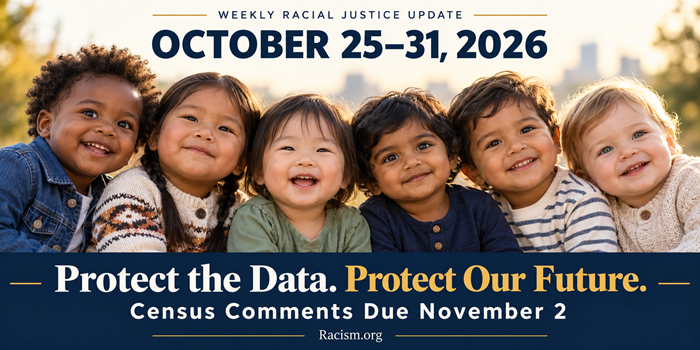
Vernellia R. Randall, “Weekly Racial Justice Update: October 25–31, 2026,” Race, Racism and the Law (November 1, 2026).
Racial justice depends on whether people can secure housing, obtain medical care, practice their religion, and elect representatives who can act on their priorities. This week’s developments show how government and institutional decisions restrict those opportunities—and how communities organize to challenge those restrictions.
The Census proposal is the immediate priority. Comments are due November 2. Removing racial and ethnic questions would weaken the information communities need to document discrimination and demand accountability. The other stories connect that struggle to voting, housing, healthcare, education, and Indigenous rights.
Table of Contents
- Census: Submit Comments by November 2
- Alaska Senate Election: Federal Intervention Threatens Certification
- Asian American Communities: Texas Organizers Respond to Racist Attacks
- Black and Latino Communities: Philadelphia Organizing
- Black Political Power: Memphis Redistricting and State Control
- Black Women in Georgia Prisons: Breast Cancer Care
- Caribbean Reparations
- Environmental Justice: Scrutinizing Data Centers
- Haitian Deportees: Insecurity and Family Separation
- HBCU Students Challenge Surveillance
- Housing: Atlanta Evictions and Black Displacement
- Housing: Vermont Homeownership Assistance
- Immigration Enforcement: Student’s Reported Injury
- Immigration Enforcement: Central Valley Farmworker Communities
- Indigenous Education: Beaded Graduation Cap Lawsuit
- Indigenous History: Wabanaki Marker at Acadia
- Indigenous Religious Rights in Prison
- Muslim and LGBTQ Communities: Wisconsin Official Resigns
- Native Voting Rights
- Ohio Governor’s Race: Attack Ad Against Amy Acton
- Perceived Middle Eastern Identity: Alleged Threats
- Reproductive Healthcare Access
Accuracy Note: Tallahassee Polling-Site Concerns
Share the Information. Support the Work.
Search and Source Note
1. Census: Submit Comments by November 2
The Census Bureau has extended the public-comment deadline on its proposed residence criteria and restrictions on demographic questions to November 2, 2026. Comments should identify Docket USBC-2026-0628.
The proposal would prohibit questions about race, ethnicity, and sexual orientation on the decennial census short form and other questionnaires used to enumerate the population. It would also exclude foreign citizens who are neither U.S. citizens nor lawful permanent residents from congressional apportionment. Other provisions would change how usual residence is determined.
The restrictions would not prohibit demographic questions on the American Community Survey and other surveys that do not enumerate the population.
Why it matters:
We cannot challenge racial discrimination effectively without information that documents it. Removing racial and ethnic questions would weaken that evidence. Excluding residents from apportionment would also change whose presence counts toward congressional representation. Both proposals threaten accountability and fair representation. Submit comments opposing them by November 2.
Take action:
Explain how your community, organization, research, or civil-rights work depends on accurate population and demographic information. Identify the provisions you oppose and describe their consequences. Visit Regulations.gov and search USBC-2026-0628.
U.S. Census Bureau, “Decennial Census of the Population of Americans; Proposed Residence Criteria and Proposed Regulations for Demographic Questions,” Federal Register, September 10, 2026. https://www.govinfo.gov/content/pkg/FR-2026-09-10/html/2026-18481.htm (last visited November 1, 2026).
U.S. Census Bureau, “Decennial Census of the Population of Americans; Proposed Residence Criteria and Proposed Regulations for Demographic Questions; Extension of Comment Period,” Federal Register, October 5, 2026. https://www.govinfo.gov/content/pkg/FR-2026-10-05/html/2026-20328.htm (last visited November 1, 2026).
2. Alaska Senate Election: Federal Intervention Threatens Certification in Race Involving Mary Peltola
Alaska asked a federal court to dismiss the Justice Department’s lawsuit seeking to delay certification if Republican Senator Dan Sullivan loses under circumstances the department attributes to confusion with another candidate, Daniel J. Sullivan. The state argued that the lawsuit lacks a legal basis and threatens election integrity.
During the week, federal officials confirmed related investigations. Associated Press reporting published October 31 describes DOJ’s request to preserve and segregate ballots ranking Daniel J. Sullivan for possible examination of voter confusion. That was a government request, not a court order granting the requested relief or a finding that voters had been deceived.
Why it matters:
Alaskans have the right to choose their senator and have their votes counted under lawful procedures. Federal officials should not use their authority to obstruct certification because their preferred candidate loses. Courts must scrutinize the government’s asserted justification and protect voters’ choices. The stakes include Alaska Native representation and equal treatment of candidates.
Liz Ruskin, “State of Alaska Says DOJ Lawsuit over Senate Race ‘Has No Legal Basis,’” Alaska Public Media, October 27, 2026. https://alaskapublic.org/news/politics/elections/2026-10-27/state-of-alaska-says-doj-lawsuit-over-senate-race-has-no-legal-basis (last visited November 1, 2026).
James Brooks, “As Alaskans Vote, State’s Top Federal Prosecutor Confirms Criminal Investigation of Dem Groups,” Alaska Beacon, October 30, 2026. https://alaskabeacon.com/2026/10/30/as-alaskans-vote-states-top-federal-prosecutor-confirms-criminal-investigation-of-dem-groups/ (last visited November 1, 2026).
Associated Press, “Justice Department Seeks to Isolate Alaska Ballots amid Criminal Probe over Senate Candidate,” carried by NPR and Maine Public, October 31, 2026. https://www.mainepublic.org/npr-news/2026-10-31/justice-department-seeks-to-isolate-alaska-ballots-amid-criminal-probe-over-senate-candidate (last visited November 1, 2026).
3. Asian American Communities: Texas Organizers Respond to Racist Attacks
American Community Media reported October 27 on hostility directed at Indian American, South Asian, and Muslim communities in Texas. Community leaders described residents questioning whether they could safely celebrate their cultures and religions in public. They also said the hostility was motivating people to organize and vote.
Organizers identified limited language assistance and inadequate outreach as additional obstacles. They emphasized reliable information and practical help, while warning against circulating unverified reports that might frighten eligible voters away from the polls.
Why it matters:
People should not have to hide their cultural or religious identity to feel safe in their communities. Texas organizers are confronting that intimidation while helping residents obtain reliable voting information and make their voices heard.
“Racist Attacks Mobilize Asian American Voters in Texas,” American Community Media, October 27, 2026. https://americancommunitymedia.org/politics/racist-attacks-mobilize-asian-american-voters-in-texas/ (last visited November 1, 2026).
4. Black and Latino Communities: Philadelphia Leaders Connect Economic Security and Community Organizing
UnidosUS reported October 29 on Philadelphia meetings involving residents, young voters, local organizations, and Black and Latino leaders. Discussions addressed housing costs, food access, healthcare, immigration concerns, and the pressures facing neighborhood businesses.
The initiative also emphasized Black–Latino coalition building and the role of trusted community organizations.
Why it matters:
Housing, food, healthcare, and economic security belong at the center of civil-rights organizing. Black–Latino coalitions strengthen residents’ ability to demand public investment and hold officials accountable for whether it reaches their neighborhoods.
UnidosUS, “Latino and Black Leaders Convene in Philadelphia to Spotlight Economic Pressures, Community Health and Voter Participation,” October 29, 2026. https://unidosus.org/press-releases/latino-and-black-leaders-convene-in-philadelphia-to-spotlight-economic-pressures-community-health-and-voter-participation/ (last visited November 1, 2026).
5. Black Political Power: Memphis Reporting Connects Redistricting and State Control
An October 26 investigation by Wendi C. Thomas examines how Tennessee state Senator Brent Taylor used legislation to override Memphis-area officials. The reporting places that record alongside his congressional candidacy in a district redrawn from majority Black to majority white.
Why it matters:
Black voters’ choices lose force when state lawmakers strip authority from the officials those voters elect. Redistricting can further weaken their influence. Protecting political participation requires attention to both who wins an election and whether elected officials retain the power to govern.
Wendi C. Thomas, “Man Who Spent Years Undermining Voters’ Interests May Win Newly Drawn District,” Truthout, October 26, 2026, republishing reporting by MLK50: Justice Through Journalism and ProPublica. https://truthout.org/articles/man-who-spent-years-undermining-voters-interests-may-win-newly-drawn-district/ (last visited November 1, 2026).
6. Black Women in Georgia Prisons Face Barriers to Breast Cancer Care
Capital B Atlanta’s October 28 reporting describes delayed screenings, difficulties obtaining medical records, and interruptions in care experienced by incarcerated women. Formerly incarcerated women and physicians challenged the gap between written policies and actual access. Georgia’s corrections department said it provides comprehensive screening and treatment services.
Why it matters:
Written prison healthcare policies do not protect women when the system delays examinations, loses records, or fails to provide follow-up care. Prison officials must explain those failures and ensure women receive timely care. Formerly incarcerated women are organizing to make the failures visible and protect those still inside.
Alyssa Johnson, “Black Women in Georgia Prisons Struggle to Get Breast Cancer Care,” Capital B Atlanta, October 28, 2026. https://atlanta.capitalbnews.org/breast-cancer-care-black-women-prison/ (last visited November 1, 2026).
7. Caribbean Reparations: Advocates Demand More Than Expressions of Sorrow
During King Charles’s Caribbean visit, reparations advocates renewed demands for concrete action addressing slavery and colonialism. Reuters reported October 30 that advocates’ proposals include debt relief, education, healthcare, development finance, and climate resilience. Britain continued to reject financial reparations.
Why it matters:
Acknowledging slavery’s brutality does not repair its continuing consequences. Caribbean advocates are demanding repair through healthcare, education, debt relief, and other institutional changes. Expressions of royal regret do not meet those demands.
Sam Tabahriti, “King Charles’ Sorrow over Slavery Faces Test as Reparations Movement Gains Ground,” Reuters, October 30, 2026, republished by Investing.com. https://www.investing.com/news/economy-news/king-charles-sorrow-over-slavery-faces-test-as-reparations-movement-gains-ground-4987169 (last visited November 1, 2026).
8. Environmental Justice: Black Organizations Help Residents Scrutinize Data Centers
The NAACP and Young, Gifted & Green developed a tool connecting residents with information about data centers and candidates’ environmental positions. Capital B’s October 27 reporting examines concerns about electricity costs, water consumption, transparency, and whether Black communities have a voice before projects are approved.
Why it matters:
Before approving data-center projects, officials must give residents access to information and a meaningful role in the decision. Developers must explain the demands on electricity and water, the environmental burdens, and who will receive the promised benefits. Black communities should not discover the costs after decisions have already been made.
Adam Mahoney, “Data Center Coming to Your Neighborhood? See Where Your Candidates Stand,” Capital B, October 27, 2026. https://capitalbnews.org/naacp-data-centers-voting-tool/ (last visited November 1, 2026).
9. Haitian Deportees: Continuing Coverage Documents Insecurity and Family Separation
A USA Today report republished by Haiti Innovation on October 30 describes people arriving in Haiti with limited support, separated from family members and struggling to secure housing and income. Earlier Human Rights Watch field research documented similar concerns about reception conditions and safety.
The October 30 date identifies the republication; the original USA Today article’s exact publication date was not established.
Why it matters:
Government accountability does not end when a deportation flight lands. It includes the conditions people face after removal and the families separated by that decision. Reporting on those consequences makes it harder for government officials to ignore the people harmed by their decisions.
Chris Kenning, “‘Not a Safe Place’: Deported Haitians Face Violence, Uncertainty,” USA Today, October 2026, republished by Haiti Innovation, October 30, 2026. https://www.haitiinnovation.org/node/942 (last visited November 1, 2026).
Human Rights Watch, “US: Deportations to Haiti Endanger Lives,” September 21, 2026. https://www.hrw.org/news/2026/09/21/us-deportations-to-haiti-endanger-lives (last visited November 1, 2026).
10. HBCU Students Challenge Surveillance Around the Atlanta University Center
Capital B Atlanta reported on students questioning Flock camera surveillance near their campuses. Their concerns include privacy, police scrutiny, and wrongful arrests. The article discusses an earlier wrongful arrest of a Clark Atlanta doctoral student and his subsequent lawsuit.
Students held a protest October 21; the reporting appeared October 26 and was updated October 28.
Why it matters:
Campus administrators and police must explain who can access surveillance information, how it is used, and how they will prevent misuse. Students must be included in decisions about cameras on and around their campuses. Claims of safety require scrutiny when students fear wrongful suspicion and arrest.
Alyssa Johnson and Madeline Thigpen, “AUC Students Say Flock Surveillance Cameras Threaten Their Privacy and Safety,” Capital B Atlanta, October 26, 2026, updated October 28, 2026. https://atlanta.capitalbnews.org/atlanta-flock-cameras-auc-protest/ (last visited November 1, 2026).
11. Housing: Atlanta Tenant Organizers Demand Action Against Evictions and Black Displacement
October 26 reporting covers tenant organizations’ demands for an eviction moratorium and stronger protections in metropolitan Atlanta. Organizers highlighted the disproportionate burden on Black renters and repeated eviction filings against the same tenants. Their demonstration occurred October 24.
Why it matters:
Evictions uproot families and weaken established Black communities. Tenant protections must address the practices driving that displacement. Residents’ testimony and organizing deserve a central place in decisions about housing policy.
Chauncey Alcorn, “Tenant Advocates Demand State Action on Metro Atlanta Eviction Crisis,” Capital B Atlanta, October 26, 2026. https://atlanta.capitalbnews.org/atlanta-eviction-moratorium-demand/ (last visited November 1, 2026).
12. Housing: Vermont Nonprofits Retreat From Racial-Equity Homeownership Assistance
Vermont Public’s October 26 reporting examines nonprofits’ retreat from programs designed to address racial inequality. Champlain Housing Trust ended a program that offered eligible buyers of color down-payment assistance.
Why it matters:
Withdrawing homeownership assistance leaves the racial barriers that prompted the program in place. The institutions ending it must explain how they will address those barriers. Retreat from a remedy cannot become retreat from responsibility.
Derek Brouwer, “Fearing Trump, Vermont Nonprofits Rolled Back Racial Equity Loans,” Vermont Public, October 26, 2026, republished by Ocean State Media. https://www.oceanstatemedia.org/new-england-news-collaborative/2026-10-26/fearing-trump-vermont-nonprofits-rolled-back-racial-equity-loans (last visited November 1, 2026).
13. Immigration Enforcement: Congressman Seeks Investigation After Student’s Reported Injury
Representative Salud Carbajal demanded an investigation October 30 into the reported detention and injury of Erik Zepeda, a U.S. citizen and student with disabilities. His letter requests records concerning identity verification, force, disability procedures, and safeguards against profiling.
The letter also acknowledges ICE’s account that agents believed Zepeda matched someone they sought and resisted commands.
Why it matters:
The reported detention and injury of a student with disabilities demands a full account of what happened. Investigators must examine identity verification, disability procedures, and the use of force. DHS and ICE should preserve relevant records and provide a substantive response. An assurance that officers followed policy does not resolve those questions.
Office of Representative Salud Carbajal, “Carbajal Demands Full Investigation Following Wrongful Detention and Injury of Santa Maria High School Student,” October 30, 2026. https://carbajal.house.gov/news/documentsingle.aspx?DocumentID=3546 (last visited November 1, 2026).
14. Immigration Enforcement: Latino Farmworker Communities Describe Fear During Central Valley Operations
Reuters reported October 31 on intensified immigration arrests in California’s Central Valley and their effects on Latino families and businesses. Residents and advocates described fear affecting daily activities and political participation.
Claims of voter intimidation remain disputed; the reporting includes government and political responses.
Why it matters:
Immigration enforcement reaches beyond the person arrested. Families lose caregivers, workers fear leaving home, and citizens worry about exposing relatives to detention. Government officials must answer for those consequences, including allegations that fear is discouraging lawful political participation.
Kristina Cooke and Marisa Taylor, “ICE Raids in a California Toss-Up District Spark Accusations of Voter Intimidation,” Reuters, October 31, 2026. https://www.reuters.com/legal/government/ice-raids-california-toss-up-district-spark-accusations-voter-intimidation-2026-10-31/ (last visited November 1, 2026).
15. Indigenous Education: Native Graduate Challenges Removal of Her Beaded Graduation Cap
KRQE reporting, updated October 27 in republication, describes Genesis White Bull’s lawsuit against Farmington Municipal Schools. It concerns a school official’s demand that she replace her Native American beaded graduation cap during her 2024 graduation.
The lawsuit alleges violations of her rights; those allegations are not a final court judgment.
Why it matters:
Indigenous students should be able to celebrate graduation without surrendering their cultural and religious identity. Schools must explain rules and decisions that impose that choice. White Bull is using the lawsuit to demand accountability for what happened at her graduation.
Jessica Barron, “Farmington High School Graduate Told to Remove Native American Beaded Cap Files Lawsuit,” KRQE, republished by AOL, updated October 27, 2026. https://www.aol.com/articles/farmington-high-school-graduate-told-034352000.html (last visited November 1, 2026).
16. Indigenous History: Removal of Wabanaki Marker at Acadia Raises Concerns About Erasure
An October 31 Associated Press article carried by ICT examines removal of a marker explaining Cadillac Mountain’s sacred significance to Wabanaki people. Wabanaki leaders described the removal as a setback to relationships built through consultation and collaboration.
The reporting does not establish that the removal itself occurred this week.
Why it matters:
Removing Wabanaki history from public interpretation makes Indigenous people less visible on their own homelands. National parks have a responsibility to tell that history accurately and respect the relationships built with Indigenous nations.
Associated Press, “At Cadillac Mountain, a Missing Wabanaki Marker and the Fight over What National Parks Should Tell,” ICT, October 31, 2026. https://ictnews.org/news/at-cadillac-mountain-a-missing-wabanaki-marker-and-the-fight-over-what-national-parks-should-tell/ (last visited November 1, 2026).
17. Indigenous Religious Rights: Incarcerated Mescalero Apache Man Challenges Restrictions on Spiritual Practices
ICT’s October 25 reporting examines Robert Paul Blalock’s allegations involving mishandled spiritual items and restrictions on sweat-lodge ceremonies and access to a ceremonial drum at California’s Centinela State Prison.
His lawsuit was filed in June; this is continuing coverage.
Why it matters:
Incarceration does not erase the importance of religion, culture, and human dignity. Prison officials must answer allegations that spiritual items were mishandled and ceremonies obstructed. Indigenous religious practices deserve respectful treatment.
Richard Arlin Walker, “Native Inmate Files Suit against California Prison over Religious Rights,” ICT, October 25, 2026. https://ictnews.org/news/native-inmate-files-suit-against-california-prison-over-religious-rights/ (last visited November 1, 2026).
18. Muslim and LGBTQ Communities: Wisconsin Official Resigns Following Discriminatory Comments
WMTV reported that McFarland Village Trustee Ken Boyd resigned October 28 after residents challenged social-media comments disparaging Muslims, LGBTQ people, and others.
The report quotes the village’s condemnation of the comments and its acknowledgment of residents who spoke out.
Why it matters:
Public officials have a responsibility to serve Muslims, LGBTQ people, and every other member of their communities. Residents challenged the comments and demanded that the village uphold that responsibility. Their action shows why speaking out against discrimination matters.
Calahan Steed, “McFarland Village Trustee Announces Resignation Following Social Media Comments,” WMTV 15 News, October 29, 2026. https://www.wmtv15news.com/2026/10/29/mcfarland-village-trustee-announces-resignation-following-social-media-comments/ (last visited November 1, 2026).
19. Native Voting Rights: Barriers Accumulate Across the Election Process
ICT’s October 29 reporting explores Native voters’ experiences with nonstandard addresses, remote polling locations, unreliable mail, and identification demands. It draws on the Native American Rights Fund’s previously released Obstacles Persist research.
Why it matters:
The right to vote means little when registration, identification, mail service, and distance repeatedly stand in the way. Election systems must account for conditions in Indian Country. Native voters should not bear the burden of overcoming procedures that disregard their communities.
Kevin Abourezk, “Study: Voter Registration in Indian Country Down 59 Percent,” ICT, October 29, 2026. https://ictnews.org/politics/study-voter-registration-in-indian-country-down-59-percent/ (last visited November 1, 2026).
Native American Rights Fund, “New Data: Native Voters Hit Roadblocks at Every Stage of Election Process,” August 26, 2026. https://narf.org/obstacles-persist-native-voters/ (last visited November 1, 2026).
20. Ohio Governor’s Race: Attack Ad Uses Amy Acton’s Childhood Abuse History Against Her
Vivek Ramaswamy’s campaign aired an ad featuring Amy Acton’s estranged mother accusing her of lying. It omitted the circumstances surrounding their estrangement: Acton and her brother were removed from their mother’s custody after her stepfather was charged with sexually assaulting Acton as a child. Ohio public-radio reporting examined supporting records.
By October 29, the ad was no longer airing. Ramaswamy said its scheduled run had ended. The ad drew bipartisan condemnation, while Trump and Vance defended it.
Why it matters:
Childhood sexual abuse should never become a weapon for discrediting a survivor. Candidates must answer for campaign decisions that exploit a survivor’s childhood trauma. Political ambition does not excuse that cruelty.
Jo Ingles, “What Effect Will Ramaswamy’s Controversial Ad Have on the Campaign for Ohio Governor?” The Statehouse News Bureau, October 21, 2026. https://www.statenews.org/government-politics/2026-10-21/what-effect-will-ramaswamys-controversial-ad-have-on-the-campaign-for-ohio-governor (last visited November 1, 2026).
Associated Press, “Controversial Attack Ad Featuring Democrat’s Estranged Mother Is off the Air in Ohio,” Spectrum News, October 30, 2026. https://spectrumnews1.com/oh/columbus/politics/2026/10/30/controversial-attack-ad-featuring-democrat-s-estranged-mother-is-off-the-air-in-ohio (last visited November 1, 2026).
21. Perceived Middle Eastern Identity: CAIR Reports Hate-Crime Charges Following Alleged Threats
CAIR-Chicago reported October 29 that an Illinois man had been charged with hate crimes following alleged threats and harassment against a woman perceived as Middle Eastern. The organization’s statement, citing prosecutors and local reporting, describes alleged anti-Middle Eastern language and a threat involving a grenade.
The allegations have not been established by a conviction. The woman’s actual religion or ethnicity should not be inferred from the alleged attacker’s language.
Why it matters:
People can become targets because of what someone assumes about their ancestry or religion. Threats based on perceived identity endanger individuals and intimidate wider communities. Accountability requires a fair legal process and serious attention to the alleged harm.
Council on American-Islamic Relations, “CAIR-Chicago Welcomes Hate Crime Charges After Man Allegedly Threatens ‘Middle Eastern’ Woman, Calls Her ‘Terrorist,’” October 29, 2026. https://www.cair.com/press_releases/cair-chicago-welcomes-hate-crime-charges-after-man-allegedly-threatens-middle-eastern-woman-calls-her-terrorist/ (last visited November 1, 2026).
22. Reproductive Health: Survey Documents Gaps for Asian American, Native Hawaiian, and Pacific Islander Respondents
October 27 reporting examines NAPAWF’s survey of 1,200 women and gender-expansive people across more than 20 ethnic backgrounds. The organization reports that 42% lacked a reproductive healthcare provider and 57% were caregivers.
These figures describe survey respondents and should not obscure differences among communities.
Why it matters:
Healthcare policy must account for the experiences of Asian American, Native Hawaiian, and Pacific Islander communities. Language access, caregiving responsibilities, and economic pressures shape whether people can obtain care. Research must document these experiences while preserving the differences among these communities.
National Asian Pacific American Women’s Forum, “In Focus: The 2026 National AANHPI Women+’s Survey.” https://napawf.org/research/infocus/ (last visited November 1, 2026).
Kelcie Moseley-Morris, “Many Asian American, Pacific Islander Women Don’t Have a Reproductive Health Provider,” Stateline, October 27, 2026. https://stateline.org/2026/10/27/nearly-half-of-aapi-women-lack-a-reproductive-health-provider-survey-finds/ (last visited November 1, 2026).
Accuracy Note: Tallahassee Polling-Site Concerns
WFSU reported October 25 that Border Patrol agents seen at a Tallahassee polling location had stopped hoping to vote. Officials said they left after learning they could not vote there because they were not county residents.
The incident should not be described as a confirmed immigration-enforcement operation targeting voters.
Regan McCarthy, “Border Agents Looking to Vote Raised Concerns at a Tallahassee Polling Site,” WFSU, October 25, 2026. https://news.wfsu.org/wfsu-local-news/2026-10-25/border-agents-looking-to-vote-raised-concerns-at-a-tallahassee-polling-site (last visited November 1, 2026).
Information becomes a tool for change when we use it. Share this update with your organizations, colleagues, family, and social networks. Discuss the developments affecting your community, support the journalists documenting them, and bring reliable sources to the conversation on Race, Racism and the Law.
Submit your Census comment by November 2 and encourage others to do the same.
Search and Source Note
This update draws on live searches and source checks conducted November 1, 2026, including minority-community journalism, local reporting, government documents, and civil-rights organizations. Earlier events receiving new coverage are identified. Allegations, requests for investigations, and preliminary proceedings are distinguished from final findings. Organizational accounts are attributed, and republication dates are distinguished from original publication dates. The Race and Law Facebook page could not be accessed and was not used as evidence.
Vernellia R. Randall, Professor Emerita of Law, University of Dayton School of Law. This article was drafted with the assistance of ChatGPT, an AI language model. ChatGPT assisted with live source discovery, source comparison, organization, and drafting. Professor Randall retains responsibility for editorial review and publication decisions. Wikipedia was used, if at all, only to identify possible leads and was not used as a final cited source.