
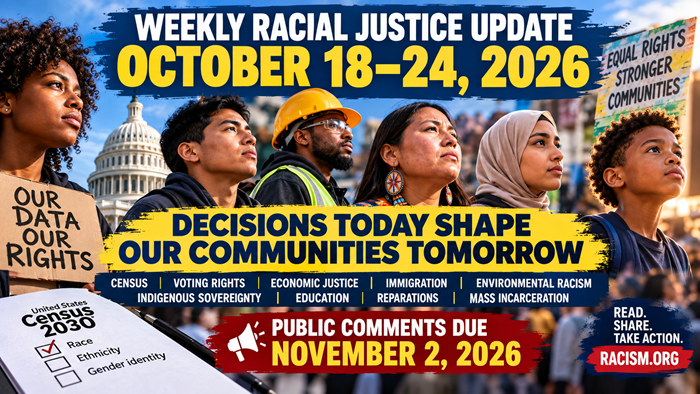
Vernellia R. Randall, Weekly Racial Justice Update: October 18–24, 2026, Racism.org (October 27, 2026).
This week's racial justice developments show how government decisions shape people's daily lives. Black workers continue to face substantially higher unemployment than white workers. Immigrant communities confront expanded detention and immigration enforcement. Indigenous nations are fighting for authority over their lands, water, and political future. At the same time, courts are considering challenges involving voting rights, educational opportunity, and government restrictions on racial-equity programs.
Communities are not waiting for government institutions to protect their rights. Black residents are challenging environmental pollution and workplace discrimination. Latino communities are organizing to protect voting access. Native nations are advancing their claims to self-government. Students, workers, and civil-rights organizations continue to demand accountability.
These developments share an important connection: legal rights depend on whether government and other institutions respect and enforce them. They also depend on whether communities have the information needed to document discrimination.
That is why the Census Bureau's proposed regulations remain especially urgent. Removing racial and ethnic questions from the 2030 Census would weaken the evidence needed to identify and challenge racial inequality for years to come.
This update covers developments from October 18 through October 24, 2026, with significant subsequent developments identified separately.
Table of Contents
- Census Comments Must Be Submitted by November 2
- AAPI Voters Express Concerns About Economic Security and Political Representation
- Alaska Election Lawsuit Raises Concerns About Certification and Indigenous Representation
- Asthma Report Identifies Serious Environmental Health Disparities in Black Communities
- Black Firefighter Challenges Alleged Racial Harassment and Retaliation
- Black Unemployment Remains Nearly Twice the White Rate
- Black Women in Political Office Describe Retaliation for Speaking Out
- California Ballot Dispute Raises Concerns About Eligible Voters
- Chicago Police Officer Alleges Anti-Muslim and Anti-Palestinian Workplace Discrimination
- Court Rejects Justice Department Attempt to End NAACP Pollution Lawsuit
- Deaf Prisoners Seek Court Intervention Over Access to Food and Medicine
- Federal Judge Orders Halt to Noncitizen Voting Investigations in Nine States
- Fifth Circuit Denies Constitutional Right to Immigration Bond Hearings
- Florida A&M Students Challenge Campus Police Cooperation With ICE
- Florida Executes Black Vietnam Veteran After Dispute Over Mitigating Evidence
- Hawai‘i Housing Program Reaches 100 Lahaina Fire-Affected Families
- Latino Communities Organize to Protect Voting Access
- Mississippi Appeals Court Removes Injunction Against DEI Restrictions
- Muslim and Arab American Voters Confront Anti-Muslim Political Rhetoric
- Native Maternal Health Research Receives More Than $5 Million
- Navajo Nation Advances Authority to Protect Tribal Waters
- New York City Delivers Immigration Rights Information in Spanish
- Reparations Advocates Continue Organizing Despite Federal Opposition
- South Asian American Studies Receives $750,000 University Grant
- Students Protest Racist Conduct at New York High School
- Supreme Court Leaves Protections for Transgender Prisoners' Health Care in Place
- Supreme Court to Review Middle School Admissions Policy
- United Houma Nation Advances Federal Recognition Petition
- University Law School Retains Name Change Addressing Anti-Native Violence
Overall Bottom Line | Search and Source Note
1. Census Comments Must Be Submitted by November 2
Continuing Action Alert
The Census Bureau has extended the deadline for public comments on proposed changes to the decennial census from October 13 to November 2, 2026.
The proposed regulations contain two significant changes:
- Proposed 15 CFR § 60.4 would exclude from congressional apportionment foreign citizens who are neither U.S. citizens nor lawful permanent residents. This would include undocumented immigrants and certain other lawful noncitizen residents.
- Proposed 15 CFR § 70.2 would prohibit questions about race, ethnicity, and sexual orientation on the decennial census short-form questionnaire or other questionnaires used for population enumeration.
The proposals are independent and remain under consideration. Neither has become a final regulation.
Why It Matters: The Census is not simply a population count. It provides the evidence needed to expose racial inequality. Removing racial and ethnic questions would make it harder to prove discrimination in voting, housing, education, employment, and health. Black, Latino, Indigenous, Asian, and other communities would lose an important tool for demanding accountability. Excluding residents from apportionment would also raise serious constitutional and political questions about representation.
Bottom Line: We cannot challenge racial discrimination effectively if the government stops collecting the information needed to document it. The November 2 deadline matters because the information omitted from the 2030 Census cannot be collected retroactively after the next administration takes office.
Take Action: Submit comments opposing the removal of racial and ethnic questions and the proposed exclusions from congressional apportionment. Reference Docket USBC-2026-0628.
Sources:
Census Bureau, “Decennial Census of the Population of Americans; Proposed Residence Criteria and Proposed Regulations for Demographic Questions,” September 10, 2026. https://www.govinfo.gov/content/pkg/FR-2026-09-10/html/2026-18481.htm
Census Bureau, “Extension of Comment Period,” October 5, 2026. https://www.govinfo.gov/content/pkg/FR-2026-10-05/html/2026-20328.htm
Federal Rulemaking Portal — Search Docket USBC-2026-0628 and select the comment option. https://www.regulations.gov
2. AAPI Voters Express Concerns About Economic Security and Political Representation
An October 21 report examining AP-NORC and AAPI Data research found substantial dissatisfaction among Asian American and Pacific Islander adults with the administration's performance.
The reported approval rating was approximately 25%, with economic security, health care, immigration, and foreign policy among the major concerns. Survey findings also indicated differing political attitudes within Asian American and Pacific Islander communities.
These are survey findings, not predictions of election results.
Why It Matters: Asian American, Native Hawaiian, and Pacific Islander communities are often treated as one political constituency despite substantial differences in income, immigration history, language, and national origin. These differences affect access to health care, economic opportunity, and political representation. Treating these communities as a single group can conceal the needs of smaller and less politically visible populations.
Bottom Line: Political parties cannot claim to represent Asian American and Pacific Islander communities while ignoring differences in income, language, immigration history, and access to services. Effective representation requires policies that respond to those differences.
Sources:
AsAmNews, “Are AAPI Voters Anti-Trump? Poll of AAPI Sentiments Released,” October 21, 2026. https://asamnews.com/2026/10/21/aapi-voters-trump-approval-2026-survey-midterms/
3. Alaska Election Lawsuit Raises Concerns About Certification and Indigenous Representation
On October 22, the Justice Department filed a lawsuit seeking to prevent certification of Alaska's U.S. Senate election under specified circumstances if incumbent Republican Senator Dan Sullivan loses.
The government alleges that voters might confuse the incumbent with another candidate who has a similar name. Democratic candidate Mary Peltola, who is Alaska Native, and Democratic Party organizations are challenging the government's position.
The lawsuit is pending. No court has found that racial discrimination motivated the government's action.
Why It Matters: Election results must be determined by voters, not by federal efforts to delay certification without a sufficient legal basis. The dispute has particular importance for Alaska Native political representation because Mary Peltola is a candidate. The racial significance of that consequence should not be confused with proof of discriminatory intent.
Bottom Line: Federal officials must provide a sound legal basis and credible evidence before asking a court to interfere with election certification. Alaska Native voters, like all voters, are entitled to have their votes counted and the results determined under established law.
Sources:
Alaska Public Media, “Peltola, Democratic Party Move to Intervene in DOJ Election Lawsuit,” October 24, 2026. https://alaskapublic.org/news/politics/2026-10-24/peltola-democratic-party-move-to-intervene-in-doj-election-lawsuit
Democracy Docket, “Alaska U.S. Senate Election Certification Challenge,” October 22, 2026. https://www.democracydocket.com/cases/alaska-u-s-senate-election-certification-challenge-doj/
4. Asthma Report Identifies Serious Environmental Health Disparities in Black Communities
On October 23, the NAACP released a national analysis documenting how air quality, housing conditions, and neighborhood characteristics contribute to unequal asthma outcomes.
The analysis drew on a community wellness survey involving nearly 23,000 respondents across 47 states, Washington, D.C., and Puerto Rico.
According to the NAACP, Black Americans are five times more likely to visit an emergency department because of asthma and experience asthma-related deaths at twice the rate of white Americans. The analysis identifies concentrated burdens in communities including the Bronx, West Philadelphia, and historically Black neighborhoods in other major cities.
Why It Matters: Asthma disparities are not simply questions of individual medical care. They reflect where people live, the conditions of their housing, and their exposure to environmental hazards. Black communities have experienced decades of unequal environmental protection and public investment. Those conditions continue to affect health.
Bottom Line: Health equity requires more than treating asthma after people become sick. Government must address the pollution, housing conditions, and unequal investment that expose Black communities to preventable respiratory illness.
Sources:
NAACP, “New NAACP Analysis Reveals Asthma Hotspots Nationwide, Black Americans Twice as Likely to Die from Condition,” October 23, 2026. https://naacp.org/articles/new-naacp-analysis-reveals-asthma-hotspots-nationwide-black-americans-twice-likely-die
5. Black Firefighter Challenges Alleged Racial Harassment and Retaliation
An October 20 report describes a federal discrimination lawsuit brought by Black firefighter Randy Brown against South Carolina's St. John's Fire District and its leadership.
Brown alleges that officials failed to investigate adequately after he discovered a noose around the neck of a dark-skinned CPR training mannequin. According to his complaint, officials subsequently treated him as a suspect rather than adequately addressing his concerns.
These allegations remain subject to litigation.
Why It Matters: A noose is not an ordinary workplace insult. It carries the history of lynching and racial terror directed against Black Americans. When an employee reports such an incident, the employer's response determines whether racial harassment will be confronted or tolerated. Retaliation against employees who report discrimination also discourages others from speaking out.
Bottom Line: Public employers must investigate racial harassment independently and protect employees who report it. Institutional loyalty cannot replace accountability, and the responsibility for addressing discrimination belongs to the employer.
Sources:
Atlanta Black Star, “Black Firefighter Found Noose Around Black CPR Dummy, But White Fire Chief Turned on Him Instead of Finding Who Did It, Lawsuit Says,” October 20, 2026. https://atlantablackstar.com/2026/10/20/black-firefighter-found-noose-around-black-cpr-dummy/
6. Black Unemployment Remains Nearly Twice the White Rate
Federal employment data for September 2026 show an unemployment rate of 7.0% among Black workers, compared with 3.6% among white workers.
An October 23 report examined the significance of this disparity and its implications for the broader economy. The report also considered concerns about employment instability and the consequences of reductions in government jobs.
Although national unemployment remained relatively stable, Black workers experienced substantially higher unemployment.
Why It Matters: Black unemployment is not simply another economic statistic. It reflects unequal access to jobs, economic security, and wealth-building opportunities. When federal employment contracts, Black workers face the potential loss of jobs that have historically provided an important path to economic stability.
Bottom Line: Economic recovery cannot be called successful while Black workers continue to experience unemployment at nearly twice the white rate. Racial disparities must be central to how we measure economic progress.
Sources:
Bureau of Labor Statistics, “Unemployment Rate Little Changed at 4.2 Percent in September 2026,” October 9, 2026. https://www.bls.gov/opub/ted/2026/unemployment-rate-little-changed-at-4-2-percent-in-september-2026.htm
TheGrio, “Black Unemployment Is Nearing Twice the White Rate. Economists Say America Should Pay Attention,” October 23, 2026. https://thegrio.com/2026/10/23/black-unemployment-is-nearing-twice-the-white-rate-economists-say-america-should-pay-attention/
7. Black Women in Political Office Describe Retaliation for Speaking Out
An October 22 Capital B investigation examines the political backlash experienced by Black women elected officials who challenge government policies and institutional power.
The reporting includes Tennessee state Senator Charlane Oliver and the experiences of Representative Ilhan Omar. It examines how race, gender, and political dissent intersect in efforts to criticize, discipline, or discredit women serving in public office.
Why It Matters: Black women have played a central role in expanding political participation and demanding government accountability. Yet their leadership can carry consequences that other elected officials do not experience in the same way. When criticism becomes racial or gender-based intimidation, the injury extends beyond the officeholder. It affects the communities whose concerns that official represents.
Bottom Line: Black women should face the same political scrutiny as other elected officials, not additional hostility because of their race or gender. Political disagreement does not excuse discriminatory treatment or retaliation.
Sources:
Capital B, “For Black Women in Political Office, Speaking Out Can Come at a Cost,” October 22, 2026. https://capitalbnews.org/black-women-political-retaliation/
8. California Ballot Dispute Raises Concerns About Eligible Voters
The Justice Department sought to have California segregate ballots associated with more than 20,000 registered voters whom federal officials identified as possible noncitizens.
California election officials challenged the reliability of the federal government's information and warned that eligible voters could be denied the opportunity to have their ballots counted.
Post-period development: On October 26, the Ninth Circuit dismissed the administration's emergency appeal because the district court had not yet had an adequate opportunity to consider the request. The appellate court did not determine whether the affected voters were noncitizens or resolve the merits of the lawsuit.
Why It Matters: Citizenship records can be inaccurate or outdated, particularly for naturalized citizens. Government action based on unreliable records can place eligible voters at risk. Latino, Asian American, and other communities with substantial immigrant populations have particular reasons to be concerned about being wrongly identified as ineligible.
Bottom Line: An eligible citizen should not lose a vote because a government database incorrectly identifies that person as a noncitizen. Before interfering with ballots, the federal government must demonstrate that its evidence is reliable and its actions lawful.
Sources:
United States Court of Appeals for the Ninth Circuit, United States v. California, No. 26-7070, October 26, 2026. https://cdn.ca9.uscourts.gov/datastore/opinions/2026/10/26/26-7070.pdf
California Department of Justice, “Attorney General Bonta Scores Early Legal Victory Against Trump Administration’s Attempt to Interfere in California Elections,” October 26, 2026. https://oag.ca.gov/news/press-releases/attorney-general-bonta-scores-early-legal-victory-against-trump-administration%E2%80%99s
9. Chicago Police Officer Alleges Anti-Muslim and Anti-Palestinian Workplace Discrimination
A Chicago police officer filed a federal lawsuit alleging discrimination and workplace hostility connected to her Muslim religion, Asian American identity, and marriage to a Palestinian Arab.
Nilofer Nanlawala alleges that department officials failed to address hostility from colleagues and interfered with her efforts to obtain professional opportunities, medical leave, and reassignment.
The allegations have not been adjudicated.
Why It Matters: Discrimination against Muslim, Arab, Palestinian, and South Asian Americans frequently combines religious prejudice with racial and national-origin stereotypes. Employees should not have to conceal their identities or family relationships to receive fair treatment. Public institutions responsible for enforcing the law have a particular obligation to protect civil rights within their own workplaces.
Bottom Line: Police departments must investigate discrimination and protect employees who report it. Anti-Muslim and anti-Palestinian hostility cannot be dismissed as ordinary workplace disagreement.
Sources:
Bloomberg Law, “Chicago Officer Sues City Over Muslim, Palestinian Hostility,” October 21, 2026. [Subscription may be required.] https://news.bloomberglaw.com/daily-labor-report/chicago-officer-sues-city-over-muslim-palestinian-hostility
10. Court Rejects Justice Department Attempt to End NAACP Pollution Lawsuit
A federal district court in Mississippi rejected the Justice Department's attempt to dismiss the NAACP's Clean Air Act citizen lawsuit challenging gas-fired power generation associated with Elon Musk's xAI data-center operations.
The plaintiffs allege that unpermitted power generation exposes nearby communities in Mississippi and Memphis to harmful emissions. The court rejected the federal government's argument that it could unilaterally terminate the citizen lawsuit.
The court did not determine whether xAI violated the Clean Air Act. That question remains for further proceedings.
Why It Matters: Communities exposed to industrial pollution need the ability to enforce environmental laws when government regulators fail to act. The Clean Air Act's citizen-suit provisions provide an important means of challenging unlawful pollution. Allowing the federal government to terminate these lawsuits at will would weaken community protection and could shield companies from legal accountability.
Bottom Line: The federal government should enforce environmental law, not undermine communities seeking to enforce it. Residents exposed to industrial pollution must retain the ability to challenge unlawful emissions, regardless of the size or influence of the corporation involved.
Sources:
NAACP, “Judge Throws Out U.S. DOJ Attempt to Toss NAACP Case Against Elon Musk’s xAI,” October 20, 2026. https://naacp.org/articles/judge-throws-out-us-doj-attempt-toss-naacp-case-against-elon-musks-xai
11. Deaf Prisoners Seek Court Intervention Over Access to Food and Medicine
On October 21, deaf and hard-of-hearing people incarcerated in Georgia prisons sought a preliminary injunction requiring effective communication and equal access to food, medication, and medical treatment.
The lawsuit alleges that prison officials have failed to provide necessary accommodations, including sign-language interpretation and accessible information about meals and medication.
According to the plaintiffs, these failures have resulted in missed meals, missed medication, and inadequate access to health care.
Why It Matters: People who are incarcerated depend on prison officials for food, medical care, and basic communication. When prisons fail to accommodate deaf people, disabilities become an additional source of punishment. These failures compound the inequalities already present in the criminal justice system.
Bottom Line: Incarceration does not eliminate a person's right to disability accommodations, food, or necessary medical treatment. Georgia prison officials must provide effective communication and access to essential services. Failure to do so imposes additional punishment beyond the sentence ordered by the court.
Sources:
American Civil Liberties Union, “Deaf and Hard of Hearing People in Georgia Prisons Seek Order Requiring Accommodations,” October 21, 2026. https://www.aclu.org/press-releases/deaf-and-hard-of-hearing-people-in-georgia-prisons-seek-order-requiring-accommodations
12. Federal Judge Orders Halt to Noncitizen Voting Investigations in Nine States
On October 21, a federal district judge in California ordered the administration to halt certain investigations of suspected noncitizen voting in nine states until polls close on November 3.
The affected states are California, Connecticut, Georgia, Missouri, Nevada, New York, Pennsylvania, Washington, and Wisconsin.
The judge expressed serious concerns about the reliability of government citizenship records and the possibility that investigations were intimidating eligible voters and interfering with voter-assistance activities.
The judge initially stayed the order through October 23 to permit the administration to seek appellate review. This describes the initial procedural order, not a determination of its enforceability after that date.
Why It Matters: Government databases do not provide a complete, error-free record of citizenship. Naturalized citizens may be especially vulnerable to being incorrectly identified as ineligible. Investigations conducted immediately before an election can discourage lawful participation, particularly when people believe contact with election officials may lead to immigration scrutiny.
Bottom Line: The government cannot protect elections by treating eligible voters as suspects without reliable evidence. Enforcement practices must distinguish actual unlawful voting from errors in government records.
Sources:
Associated Press, “Federal Judge Orders Trump Administration to Halt Noncitizen Voting Investigation in 9 States,” October 22, 2026. https://apnews.com/article/ac8a87b135f7a2ae9fe961bab3b28825
13. Fifth Circuit Denies Constitutional Right to Immigration Bond Hearings
On October 23, the Fifth Circuit Court of Appeals, sitting en banc, ruled 10–7 that certain noncitizens who entered the United States without admission do not have a constitutional right to individualized bond hearings during immigration detention.
The decision reversed lower-court judgments that had provided relief to detained immigrants.
The ruling applies within the Fifth Circuit, which includes Texas, Louisiana, and Mississippi. Separate questions about statutory authority remain the subject of litigation.
Why It Matters: The decision substantially limits the ability of affected immigrants to obtain review of their confinement. Longtime residents, including individuals with families, employment, and no criminal convictions, can face detention without an individualized bond hearing. The ruling gives immigration status extraordinary weight while restricting protection against unnecessary confinement.
Bottom Line: Physical liberty should not depend solely on immigration status. The government should be required to justify prolonged detention through meaningful legal procedures. Immigration enforcement does not eliminate the importance of due process.
Sources:
United States Court of Appeals for the Fifth Circuit, Sosnava Rodriguez v. Vergara, No. 26-50183, October 23, 2026. https://law.justia.com/cases/federal/appellate-courts/ca5/26-50183/26-50183-2026-10-23.html
The Texas Tribune, “Trump Administration Can Hold Immigrants in ICE Custody Without Bond, Court Rules,” October 23, 2026. https://www.texastribune.org/2026/10/23/immigration-bond-detention-texas-court-ice-ruling-5th-circuit/
14. Florida A&M Students Challenge Campus Police Cooperation With ICE
Students at Florida A&M University protested the campus police department's participation in the federal 287(g) immigration enforcement program during the university's homecoming activities.
The agreement allows designated officers to perform specified immigration enforcement functions under federal authority.
Students argue that the arrangement threatens campus trust and may discourage immigrant and international students from seeking help.
University officials maintain that officers do not contact, question, detain, or arrest people solely because of suspected undocumented immigration status.
Why It Matters: Historically Black colleges and universities have a particular responsibility to provide an environment where students can learn without intimidation. When campus police participate in federal immigration enforcement, immigrant students and families may become less willing to seek assistance from the very officers charged with protecting them.
Bottom Line: A university cannot build trust between students and campus police while leaving students uncertain about when those officers may exercise immigration enforcement powers. Florida A&M should clearly disclose the scope of its agreement and demonstrate how students will be protected.
Sources:
TheGrio, “FAMU Students Protest Campus Police Cooperation With ICE,” October 24, 2026. https://thegrio.com/2026/10/24/famu-students-protest-ice-agreement/
15. Florida Executes Black Vietnam Veteran After Dispute Over Mitigating Evidence
Florida executed William Reaves Jr., a 77-year-old Black Vietnam veteran, on October 20.
Reaves was convicted of murdering a sheriff's deputy. His attorneys argued that the sentencing jury never heard important evidence concerning the effects of combat-related post-traumatic stress disorder.
Veterans and other advocates urged the state to reconsider the execution because of concerns about the mitigating evidence that was not presented during sentencing.
Why It Matters: The death penalty exposes the consequences of a criminal justice system that allows no correction after an execution. When important mitigating evidence is not presented to a sentencing jury, the reliability of the death sentence deserves serious examination. The history of racial inequality in capital punishment makes rigorous scrutiny especially important. The available reporting does not establish that racial bias determined the outcome of this case.
Bottom Line: The death penalty demands the highest standards of procedural fairness because execution is irreversible. The failure to present significant mitigating evidence raises serious questions about whether the sentence was sufficiently examined before the state carried it out.
Sources:
Death Penalty Information Center, “William Reaves, Vietnam Veteran Whose Jury Did Not Learn Critical Mitigation Evidence About His Service-Related Injury, Is Set for Execution in Florida,” October 16, 2026. https://deathpenaltyinfo.org/william-reaves-vietnam-veteran-whose-jury-did-not-learn-critical-mitigation-evidence-about-his-service-related-injury-is-set-for-execution-in-florida
Death Penalty Information Center, “Executions in 2026.” https://deathpenaltyinfo.org/executions/2026
16. Hawai‘i Housing Program Reaches 100 Lahaina Fire-Affected Families
An October 23 report describes the hundredth family receiving assistance through Maui County's first-time homebuyer program for people affected by the Lahaina fires.
The program provides financial assistance to eligible households seeking permanent housing.
The report also describes the continuing difficulties displaced residents face, including limited housing availability, high costs, and the challenges of remaining connected to Lahaina.
Why It Matters: Disaster recovery is also a question of racial and economic justice. Native Hawaiian and other longstanding local families face the possibility of permanent displacement when housing becomes unaffordable. Recovery programs must consider not only the number of homes purchased but also whether families can remain in communities where they have cultural, historical, and family connections.
Bottom Line: Successful disaster recovery means helping displaced families return and remain in their communities. Government assistance should protect community survival rather than allow disasters to accelerate displacement.
Sources:
AsAmNews, “100th Lahaina Family Awarded Homebuyer Grant After Fires,” October 23, 2026. https://asamnews.com/2026/10/23/maui-first-time-homebuyer-program-lahaina-fire-survivors/
17. Latino Communities Organize to Protect Voting Access
An October 22 report describes residents in Los Angeles organizing neighborhood voter-protection efforts as immigration enforcement creates anxiety among immigrant families.
Community members are receiving training to assist voters, provide accurate information, and respond to concerns about intimidation.
The organizing includes Spanish-speaking residents and community organizations working in neighborhoods affected by federal immigration enforcement.
Why It Matters: The right to vote means little if eligible citizens are afraid to exercise it. Naturalized citizens and people living in mixed-status families may experience particular concern when immigration enforcement becomes closely associated with public institutions. Community organizations can help residents distinguish their legal rights from the fear created by aggressive enforcement practices.
Bottom Line: Protecting Latino voting rights requires more than keeping polling places open. Government must prevent intimidation, while community organizations need the resources to provide accurate information and meaningful assistance.
Sources:
LAist, “Neighbors Are Stepping Up to Protect the Polls as Fears of ICE Persist,” October 22, 2026. https://laist.com/news/politics/neighbors-are-stepping-up-to-protect-the-polls-as-fears-of-ice-persist
18. Mississippi Appeals Court Removes Injunction Against DEI Restrictions
On October 22, the Fifth Circuit vacated a preliminary injunction against Mississippi's law restricting diversity, equity, and inclusion activities in public educational institutions.
The appellate court sharply criticized the district court's handling of the case, including serious factual and citation errors associated with unverified artificial-intelligence-generated material.
The court ordered reassignment to another district judge.
The decision removes the preliminary injunction but does not finally decide whether the challenged statutory provisions are constitutional. The law includes certain exceptions for academic and student activities.
Why It Matters: Mississippi's restrictions affect institutions responsible for teaching students and addressing discrimination. When universities face legal and financial consequences for prohibited diversity activities, they may become reluctant to undertake even lawful work involving racial inequality. The appellate court's criticism of the district judge's errors is serious, but it does not establish that the restrictions are constitutional.
Bottom Line: Judicial errors must be corrected. So must unconstitutional government restrictions. The Fifth Circuit's decision addresses the first issue without finally resolving the second.
Sources:
United States Court of Appeals for the Fifth Circuit, Jackson Federation of Teachers v. Fitch, No. 25-60496, October 22, 2026. https://www.ca5.uscourts.gov/opinions/pub/25/25-60496-CV0.pdf
Associated Press, “Mississippi DEI Ban Can Go Into Full Effect After Fifth Circuit Reversal,” October 23, 2026. https://apnews.com/article/mississippi-dei-ban-diversity-equity-inclusion-1b8404edade410aba9f04c1a0cdff419
19. Muslim and Arab American Voters Confront Anti-Muslim Political Rhetoric
An October 23 report examines dissatisfaction among some Muslim and Arab American voters in Michigan over political rhetoric directed at Democratic Senate candidate Abdul El-Sayed.
The report describes criticism of President Trump's statements associating El-Sayed with extremism and the Muslim Brotherhood.
Muslim and Arab American community members have challenged the rhetoric, arguing that it relies on religious stereotypes and stigmatizes Muslim political participation.
Why It Matters: Associating Muslim candidates with terrorism or extremism without substantiated evidence reinforces stereotypes that have long been used to marginalize Muslim Americans. Such rhetoric also affects Arab Americans and other communities frequently subjected to anti-Muslim prejudice, including people who are not Muslim. Religious identity must not become a substitute for evidence.
Bottom Line: Muslim and Arab Americans must be able to participate fully in political life without their religion or identity being turned into an accusation of disloyalty. Political criticism must address conduct and policy rather than rely on prejudice.
Sources:
AsAmNews, “Muslim and Arab Americans Feel Betrayed by Republicans,” October 23, 2026. https://asamnews.com/2026/10/23/michigan-muslim-arab-american-voters-trump-betrayal-abdul-el-sayed/
20. Native Maternal Health Research Receives More Than $5 Million
The University of Oklahoma received more than $5 million in federal research funding for maternal health projects, including work intended to improve health outcomes among American Indian and Alaska Native mothers.
The projects will examine culturally responsive care, access to health services, nutrition, technology, and the use of health data.
Several projects involve Native communities and research partnerships.
Why It Matters: Native mothers experience health-care systems shaped by longstanding underinvestment, geographic barriers, and disregard for Indigenous knowledge. Research that excludes tribal leadership risks repeating the same institutional failures it claims to address. Indigenous communities must have a meaningful role in determining which problems are studied and how research findings are used.
Bottom Line: The funding is an important beginning, but the measure of success will be whether Native mothers receive better care. Tribal communities must help determine research priorities and how the findings are used.
Sources:
Native News Online, “$5 Million in Maternal Health Research Funding to Support Projects Aimed at Improving Outcomes for Native Mothers,” October 20, 2026. https://nativenewsonline.net/health/5-million-in-maternal-health-research-funding-to-support-projects-aimed-at-improving-outcomes-for-native-mothers/
21. Navajo Nation Advances Authority to Protect Tribal Waters
On October 21, the Environmental Protection Agency approved the Navajo Nation's application for treatment in a manner similar to a state under specified Clean Water Act programs.
The Navajo Nation became the first tribal nation to receive this approval for the National Pollutant Discharge Elimination System and sewage-sludge management programs.
The approval allows the Nation to seek authorization to administer those regulatory programs. It does not constitute final authorization to operate them.
Why It Matters: Tribal sovereignty means having the authority to protect tribal lands and water, not simply being consulted about decisions made elsewhere. The Navajo Nation's progress toward regulating pollution is an important step toward exercising that authority. Indigenous communities should not have to depend entirely on outside governments to protect their water resources.
Bottom Line: Recognition of tribal authority must be followed by the resources and regulatory approvals needed to exercise it. Sovereignty without the ability to enforce environmental protections remains incomplete.
Sources:
Environmental Protection Agency, “Navajo Nation Becomes First Tribe Eligible to Administer Clean Water Act Permitting Programs,” October 21, 2026. https://www.epa.gov/newsreleases/navajo-nation-becomes-first-tribe-eligible-administer-clean-water-act-permitting
22. New York City Delivers Immigration Rights Information in Spanish
On October 23, New York City Mayor Zohran Mamdani released a Spanish-language public message explaining legal rights during encounters with Immigration and Customs Enforcement.
The video addresses common concerns about immigration enforcement, including entry into private residences and the distinction between judicial warrants and administrative immigration documents.
The message received support from immigrant-rights advocates and criticism from political opponents.
Why It Matters: Legal protections have limited value when residents do not understand them or cannot obtain accurate information in their own language. Latino immigrants, naturalized citizens, and mixed-status families need reliable guidance about interactions with federal enforcement officers. Language access is part of meaningful access to rights.
Bottom Line: A legal right offers limited protection when a person does not understand it or cannot obtain accurate information about how to exercise it. New York City should continue providing clear immigration-rights information in Spanish and other languages used by residents.
Sources:
Latin Times, “Mamdani Goes Directly to Immigrants in Spanish — What His ICE Rights Video Actually Says,” October 24, 2026. https://www.latintimes.com/mamdanis-spanish-video-immigrant-rights-ice-600540
23. Reparations Advocates Continue Organizing Despite Federal Opposition
An October 24 Associated Press investigation examines efforts to expand reparations programs while the administration challenges race-conscious remedies.
The reporting includes Evanston, Illinois, which established a housing reparations program, and universities confronting their historical relationships to slavery.
The federal government has challenged certain reparations initiatives, while advocates continue to organize around restitution, institutional responsibility, and remedies for historical injustice.
Why It Matters: Reparations are not special treatment. They are a response to documented historical injuries and the continuing benefits institutions received from racial exploitation. Opposition to reparations cannot erase the obligations created by those injuries. The legal design of a particular program matters, but constitutional debate should not obscure the history that makes repair necessary.
Bottom Line: Institutions that benefited from slavery and racial discrimination have a responsibility to confront those histories and consider meaningful remedies. Acknowledging past injustice without addressing its continuing consequences is not accountability.
Sources:
Associated Press, “As Trump Fights Over What America Owes, Slavery Descendants Organize for the Future,” October 24, 2026. https://apnews.com/article/157c0338bc29f3c17c22bbce7c148d7c
24. South Asian American Studies Receives $750,000 University Grant
The University of California, Santa Barbara, received a $750,000 Mellon Foundation grant to develop a South Asian American Studies Center.
The funding will support an interdisciplinary research and teaching initiative intended to strengthen scholarship concerning South Asian American communities.
The initiative is being developed under the leadership of university scholars Jigna Desai and Sameer Pandya.
Why It Matters: South Asian American histories include colonialism, immigration restrictions, racial exclusion, labor struggles, and religious discrimination. These experiences are frequently overlooked or treated as indistinguishable from those of other Asian American populations. Without dedicated research and teaching, important histories remain marginalized within higher education.
Bottom Line: The history of South Asian Americans belongs in university teaching and research. Dedicated academic programs help preserve histories that have too often been excluded from the broader account of race and immigration in the United States.
Sources:
University of California, Santa Barbara, “UCSB Secures Gift to Launch a South Asian American Studies Center,” October 19, 2026. https://news.ucsb.edu/2026/022881/ucsb-secures-gift-launch-south-asian-american-studies-center
25. Students Protest Racist Conduct at New York High School
Students at Colonie Central High School near Albany, New York, organized a walkout on October 19 after a video circulated showing students repeatedly using anti-Black racial slurs.
Students and parents questioned whether the district's disciplinary response adequately addressed the incident.
District officials condemned the behavior, reported that disciplinary action had been taken, and said their investigation would continue.
Why It Matters: Racist conduct affects whether Black students can learn in an environment where they feel safe and respected. A school cannot fulfill its educational obligations when students believe racial hostility will be minimized or tolerated. Responding to racism requires both appropriate accountability and a sustained commitment to changing the conditions that allow racial hostility to persist.
Bottom Line: School officials must do more than condemn racist behavior after it becomes public. They must protect targeted students, address harassment consistently, and explain how they will prevent similar incidents. Students should not have to organize a walkout to have their concerns taken seriously.
Sources:
Atlanta Black Star, “Racist Video Rocks New York High School as Students Walk Out to Protest District’s Response,” October 21, 2026. https://atlantablackstar.com/2026/10/21/racist-video-rocks-new-york-high-school/
26. Supreme Court Leaves Protections for Transgender Prisoners' Health Care in Place
On October 21, the Supreme Court denied the administration's request to suspend a preliminary injunction protecting access to gender-affirming medical treatment for transgender people in federal custody.
The underlying litigation challenges federal prison policies restricting access to treatment.
The Court's decision permits the preliminary injunction to remain in effect while litigation continues. It does not resolve the merits of the constitutional claims.
Why It Matters: The government assumes responsibility for medical care when it incarcerates someone. Policies that restrict treatment based on transgender status raise serious questions about unequal treatment and the government's duty to provide necessary health care. The consequences can be particularly severe for incarcerated people who experience intersecting forms of racial, gender, and disability discrimination.
Bottom Line: Prison officials cannot disregard their legal obligations because a person's medical needs have become politically controversial. Access to appropriate treatment is a question of rights, not political approval.
Sources:
American Civil Liberties Union, “Supreme Court Denies Trump Administration Request to Withhold Health Care from Incarcerated Transgender People,” October 21, 2026. https://www.aclu.org/press-releases/supreme-court-denies-trump-administration-request-to-withhold-health-care-from-incarcerated-transgender-people
27. Supreme Court to Review Middle School Admissions Policy
On October 19, the Supreme Court agreed to review a challenge to Montgomery County, Maryland's admissions process for selective middle school programs.
The challengers allege that the policy discriminates against Asian American students. Lower courts dismissed the lawsuit.
The Supreme Court agreed to consider a narrow question: whether a plaintiff challenging a facially neutral admissions policy as racially discriminatory must establish that the targeted racial group experienced an aggregate disparate impact relative to its share of the applicant pool.
The Court has not decided whether the admissions policy is unlawful.
Why It Matters: Admissions policies do not operate on an equal playing field. Students enter the selection process with educational opportunities shaped by residential segregation, unequal school resources, and family wealth. Evaluating reform requires examining those inequalities rather than assuming that the existing system is neutral. The legal inquiry must also take allegations of intentional discrimination seriously and distinguish them from efforts to remove barriers.
Bottom Line: The Court's decision will affect how lower courts evaluate claims that facially neutral admissions policies discriminate by race. The legal standard must permit meaningful examination of intentional discrimination without treating every effort to expand educational opportunity as unlawful.
Sources:
Supreme Court of the United States, Association for Education Fairness v. Montgomery County Board of Education, No. 26-12, docket and October 19, 2026 order. https://www.supremecourt.gov/docket/docketfiles/html/public/26-12.html
LatinoJustice PRLDEF, “Supreme Court to Review Challenge to Admissions Policy That Increases Equal Opportunity for Middle School Students,” October 19, 2026. https://www.latinojustice.org/en/press/supreme-court-review-challenge-admissions-policy-increases-equal-opportunity-middle-school
28. United Houma Nation Advances Federal Recognition Petition
On October 19, Native News Online reported that Principal Chief Lora Ann Chaisson of the United Houma Nation had submitted supplemental documentation to the federal Office of Federal Acknowledgment on October 15.
The submission continues the Louisiana tribal nation's longstanding effort to obtain federal recognition.
The additional documentation advances the recognition process but does not itself establish federal acknowledgment.
Why It Matters: Federal recognition affects a tribal nation's government-to-government relationship with the United States and access to important federal programs and protections. Recognition processes can impose substantial documentation burdens on Indigenous nations whose historical records were shaped by colonization, displacement, and discriminatory government practices. The absence of conventional government documentation does not erase a community's history or identity.
Bottom Line: The federal acknowledgment process must evaluate tribal evidence fairly and account for the historical conditions that made documentation difficult. Indigenous nations should not be denied recognition simply because earlier government practices failed to record their existence accurately.
Sources:
Native News Online, “United Houma Nation Submits Supplemental Petition for Federal Recognition,” October 19, 2026. https://nativenewsonline.net/sovereignty/united-houma-nation-submits-supplemental-petition-for-federal-recognition/
29. University Law School Retains Name Change Addressing Anti-Native Violence
The Supreme Court declined to review a challenge to the name change of the University of California College of the Law, San Francisco, formerly UC Hastings College of the Law.
The institution changed its name after historical research connected its original namesake, Serranus Hastings, to violence against Native Americans in California.
Descendants and alumni challenged the change, but lower courts rejected their legal claims. The Supreme Court's denial of review leaves those judgments in place without adopting their reasoning.
Why It Matters: Institutional names and public honors communicate whose histories are valued and whose suffering is disregarded. Continuing to honor individuals associated with racial violence can perpetuate the exclusion of communities harmed by those actions. Institutions have a responsibility to examine their history and reconsider honors that conflict with their stated commitments to justice.
Bottom Line: Historical accountability requires more than changing a name, but institutions should not be compelled to continue honoring individuals whose actions contributed to racial violence and dispossession.
Sources:
Reuters, “California Law School Wins Fight Over Hastings Namesake as US Supreme Court Denies Challenge,” October 20, 2026. https://www.reuters.com/legal/government/california-law-school-wins-fight-over-hastings-namesake-us-supreme-court-denies-2026-10-20/
Overall Bottom Line
Racial inequality does not maintain itself. It is sustained through laws, government decisions, institutional practices, and failures to enforce existing protections. This week's developments demonstrate how those decisions affect employment, health, voting, education, immigration, and incarceration.
They also demonstrate the importance of community action. Black, Latino, Indigenous, Asian American, Muslim, and other communities continue to challenge discrimination through organizing, litigation, research, and demands for government accountability.
But these efforts depend on reliable information. Without racial data, it becomes harder to identify unequal treatment, establish patterns of discrimination, and evaluate whether government policies are working.
The Census proposal threatens that foundation. If racial and ethnic questions are removed from the 2030 Census, the missing information cannot simply be recovered after the next administration takes office.
The deadline for public comments is November 2, 2026. We need to protect the racial data that makes accountability possible.
Search and Source Note
This update covers developments from October 18 through October 24, 2026. A material October 26 election-law development is identified separately. Sources were reviewed through October 27, 2026.
Research included federal government publications, judicial decisions, national and local journalism, civil-rights organizations, and community-focused reporting. Particular attention was given to reporting concerning Black, Latino, Indigenous, Asian American, Native Hawaiian, Pacific Islander, Muslim, immigrant, and other marginalized communities.
The update distinguishes allegations from established findings, preliminary court decisions from final judgments, and racial consequences from proof of discriminatory intent. Wikipedia was not used as a substantive source.
Sources last reviewed: October 27, 2026.
Vernellia R. Randall, Professor Emerita of Law, University of Dayton School of Law. This article was drafted with the assistance of ChatGPT, an AI language model. ChatGPT assisted with live source discovery, source comparison, organization, and drafting. Professor Randall retains responsibility for editorial review and publication decisions. Wikipedia was used, if at all, only to identify possible leads and was not used as a final cited source.